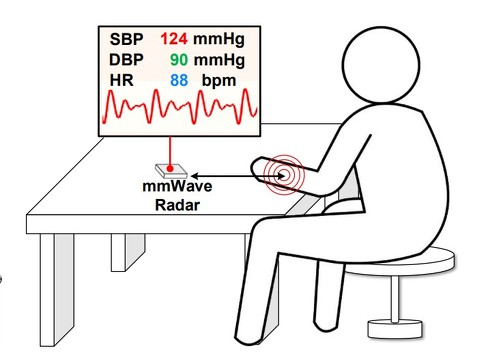
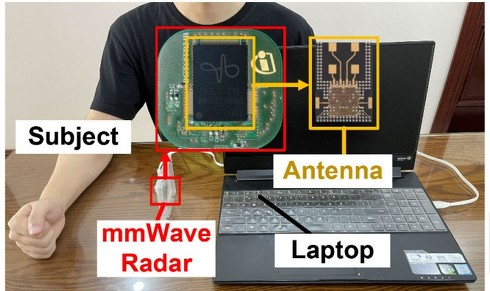
A non-contact blood pressure measurement method developed by Beijing University of Posts and Telecommunications, users do not need to wear any devices or make any physical contact. The system performs blood pressure measurement by emitting millimeter-wave signals to the user’s wrist and capturing the signals reflected back from the wrist arteries.
Experimental results show that the method can accurately estimate systolic and diastolic blood pressure with very small errors.
Thesis: https://dl.acm.org/doi/10.1145/3614439
PDF:https://dl.acm.org/doi/pdf/10.1145/3614439
Working principle:
1. Millimeter wave transmission and reception: The system transmits millimeter waves to the user’s wrist through a special device. Millimeter wave is an electromagnetic wave intermediate between microwave and infrared light in the electromagnetic spectrum.
2. Signal reflection and capture: When millimeter waves hit the wrist, it interacts with the wrist arteries and is reflected back. This reflected signal is captured by the system.
3. Data analysis and blood pressure calculation: The captured signals are processed through a series of complex data analysis and algorithms, and finally used to calculate systolic and diastolic blood pressure.
Accuracy Verification:
By comparing it with traditional blood pressure measurement methods, the researchers found that the error of this method was very small and almost negligible.
The results showed that airBP was able to accurately estimate systolic and diastolic blood pressure with a mean error of -0.30 mmHg and -0.23 mmHg and a standard deviation error of 4.80 mmHg and 3.79 mmHg (within the acceptable range specified by the FDA AAMI protocol), respectively, at a distance of up to 26 cm. Even when the surrounding area is crowded, the device can function normally regardless of brightness.
Since it is non-contact, this means it can be used for real-time or continuous blood pressure monitoring, even while the user is sleeping or working.
This technology has the potential to be widely used in a variety of scenarios, including homes, hospitals, and public spaces.