Today, the price-earnings ratio of the Hang Seng Index is 11.3, and the price-earnings ratio of Hang Seng state-owned enterprises is only 9.7, which is once again in the bottom area of history.
1. Purchase channels
1. Domestic consignment agencies.
Funds that meet the conditions for mutual recognition by the China Securities Regulatory Commission can be entrusted to mainland sales agencies for sale, and the specific trading process is the same as that of domestic funds. According to the data of Tiantian Fund, there are currently 18 Hong Kong stock funds (excluding 11 different currencies of the same fund) that meet the conditions for mutual recognition
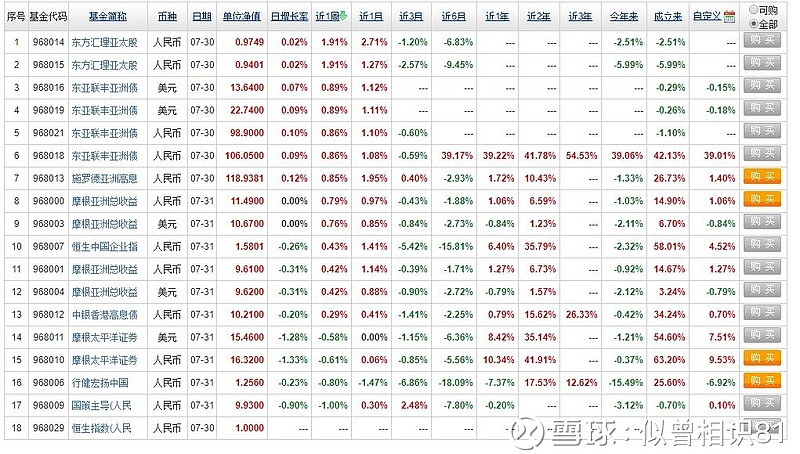
At present, the platform sells four funds, including JPMorgan Pacific Securities RMB, Schroders Asia High Dividend Equity and Bond Fund, JPMorgan Asia Total Income RMB and Zeal Promotion China, with rates basically the same as mainland funds and a 1% discount.
In addition, there are also fund companies, banks, etc. that sell the above funds, such as Tianhong Fund provides consignment sales of Xingjian Promotion China Fund, and JPMorgan Asia Total Income Bond Fund can be purchased at Shanghai Investment JPMorgan Fund Company and some banks.
The advantage of the above channels is that you can participate in the subscription with a minimum of 10-100 yuan and enjoy the convenience of global investment.
Taking JPMorgan Pacific Securities as an example, the fund is an equity fund, with a stock position of 99.1% in the first quarter, 45.3% in Japan, 18.5% in China, 9.4% in Australia, and 7.1% in Taiwan, which can make up for the regret that domestic funds invest less in the Japanese stock market.
Since its establishment in the first quarter of 2016, the fund has risen by 62.1%, and has risen by 44.35% and 11.33% in the past two years and 1 year respectively.
According to the current tax policy, before December 17, 2018, the net income of buying and selling will be temporarily exempt from individual tax, and dividends need to be deducted 20% of individual tax.
Hong Kong stock index fund
Common Hong Kong stock index funds include the Hang Seng Index, the State-owned Enterprises Index and the Hong Kong Small and Medium Index. Hang Seng Index: Reflecting the entire Hong Kong stock market, the index has been established for a relatively long time, including 50 Chinese stocks and local stocks listed on the main board of the Hong Kong Stock Exchange with the largest market capitalization and the most active trading volume.
Hang Seng China Enterprises Index: Also known as the State-owned Enterprises Index, it refers to the stocks of enterprises registered in the mainland and listed in Hong Kong, and well-known companies include Haidilao, Tencent Holdings, Xiaomi Group, Meituan and so on. Standard Hong Kong-listed China Small and Medium Cap Select Index: includes Hong Kong small and medium-cap listed companies whose main business is in the mainland, and the market value of small and medium-sized constituent stocks is mainly concentrated between 200-300 billion.
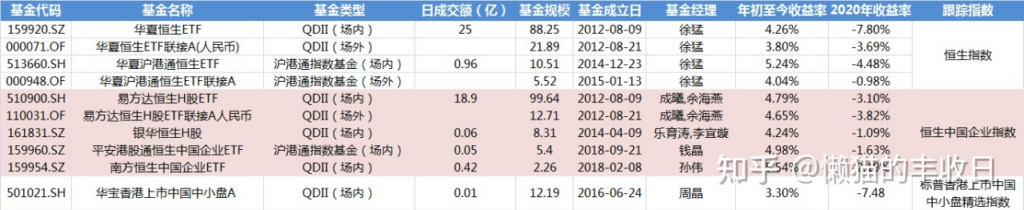
Year-to-date, funds tracking Hong Kong indices have had little more returns. However, from the perspective of fund size, ChinaAMC Hang Seng ETF and E Fund Hang Seng H shares are the largest, with 8.825 billion and 9.964 billion respectively. From the perspective of daily turnover, it is also the highest turnover of these two on-market funds.
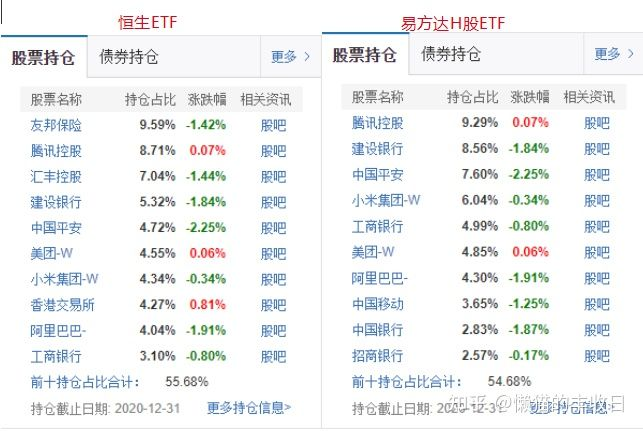
The figure below shows the top ten major stocks of these two funds, all of which have heavy positions in Tencent Holdings, China Construction Bank, Ping An of China, Meituan, Xiaomi, Alibaba, and Industrial and Commercial Bank of China, and the degree of overlap is still quite high.
Year-to-date, funds tracking Hong Kong indices have had little more returns. However, from the perspective of fund size, ChinaAMC Hang Seng ETF and E Fund Hang Seng H shares are the largest, with 8.825 billion and 9.964 billion respectively. From the perspective of daily turnover, it is also the highest turnover of these two on-market funds.
The figure below shows the top ten major stocks of these two funds, all of which have heavy positions in Tencent Holdings, China Construction Bank, Ping An of China, Meituan, Xiaomi, Alibaba, and Industrial and Commercial Bank of China, and the degree of overlap is still quite high.
QDII fund
QDII funds are funds issued in the Mainland that invest purely in overseas markets. Investing in QDII funds requires attention to exchange rate risk, domestic funds are denominated in RMB, while QDII funds are foreign currencies, such as US dollars, Japanese yen, euros, etc.
Therefore, in addition to the rise and fall of the market, fluctuations in the exchange rate will also affect the rise and fall of net worth. There are a total of 309 domestic QDII funds, 113 of which invest in Hong Kong stocks, excluding index funds, the proportion of investment in Hong Kong stocks does not exceed 50%, and the scale is less than 200 million, and there are still 13 left. Look at the picture below:
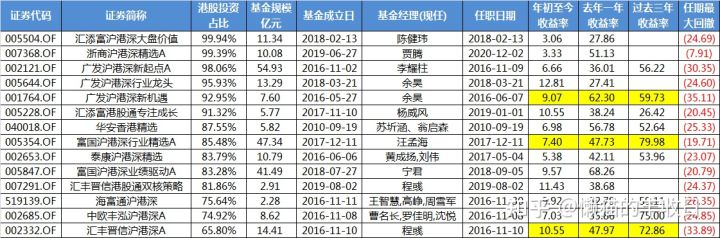
The yields of Qianhai Open Source Shanghai-Hong Kong-Shenzhen Advantage Select, which is jointly managed with Fan Jie, ranked the highest among Shanghai, Hong Kong and Shenzhen funds in the past year and the past three years, with 103.65% and 234.15% respectively.
Domestic public funds with the right to invest in Hong Kong stocks
Recently, many domestic public funds have applied for the right to allocate Hong Kong stocks, which means that in addition to buying A-shares, they will also allocate several Hong Kong stocks, such as Zhang Kun’s Blue Chip Selection, Liu Yanchun’s Jiying Growth (closed for two years), etc., but the proportion does not exceed 50%. Funds with a scale of more than 200 million, a founding date of more than one year, and an investment ratio of more than 40% in Hong Kong stocks, please take the picture.
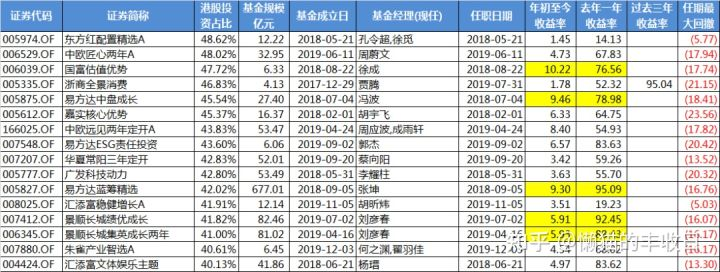
Finally, to sum up, there are four ways to invest in Hong Kong stock funds, Hong Kong stock index funds, Hong Kong stock QDII, Shanghai-Hong Kong Stock Connect funds and domestic public funds that have the right to invest in Hong Kong stocks. In addition to Hong Kong stock index funds, the latter three are active funds.
Hong Kong stock active fund
There are ways to invest in Hong Kong stock active funds include QDII, Shanghai-Hong Kong Stock Connect funds and domestic public funds that have the right to invest in Hong Kong stocks, which will be introduced next.
2. Hong Kong stock account.
By opening a Hong Kong stock account, you can purchase 195 ETFs through the market, of which the ETFs with the highest gains in the last 5 years and the last 3 years and the increase in net value are detailed in the table below:
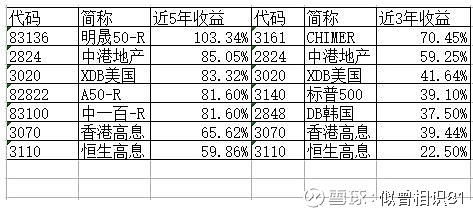
Of course, if there are Hong Kong securities firms and banks that also provide a richer selection of OTC funds, it is not suitable for the mainland public.
2. Fund classification
The biggest advantage of Hong Kong funds compared to the mainland is that they cover many regions and industries around the world, and provide some leveraged funds, which can fill the lack of domestic QDII coverage. According to past data, the annualized yield of medium and long-term global bonds is between 6% and 10%, and the yield of other types of funds is between 10% and 30%
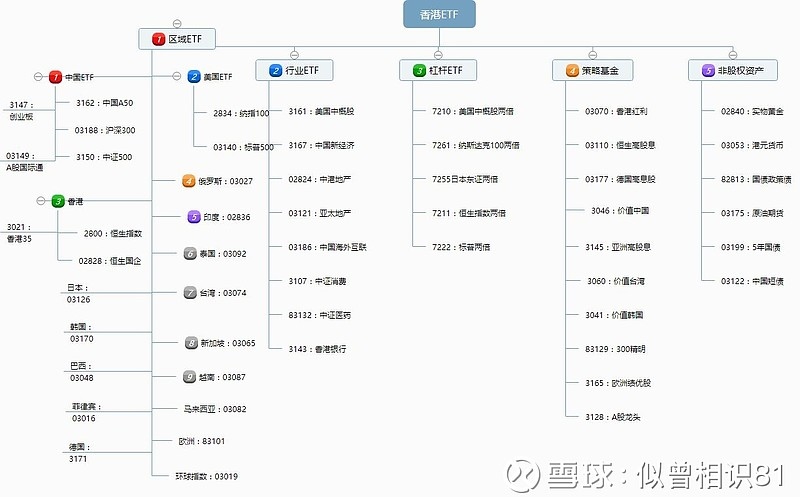
Hong Kong ETFs can be divided into many categories, according to the classification of region, industry, leverage, strategy and non-equity as above, among which the focus is on choosing large trading volume and representative ETF code markings as shown in the figure above.
Regionally, the coverage rate is the United States, China A-shares, Russia, Europe, Japan, Brazil, South Korea, India, Thailand, Singapore, Vietnam, Malaysia, Hong Kong and Taiwan.
The leveraged fund has launched a 2x leveraged fund for US Chinese stocks, Nasdaq 100, S&P 500, Japan’s Topix and Hang Seng Index.
The strategy has launched strategic funds based on dividends, value, quality and other factors, including Hong Kong dividends, German high dividends, Asian high dividends, value China, value Taiwan, value South Korea, European performance, A-share industry leaders and other indexes.
The non-equity category includes ETFs of Hong Kong dollar currency, Chinese short-term bonds, 5-year treasury bonds, treasury bonds and policy bonds, crude oil futures and physical gold.
The more distinctive ETFs are introduced as follows:
Hong Kong Dividend ( Code 03070):
The full name is Ping An Hong Kong High Dividend Stocks, which tracks the CSI Hong Kong Dividend Index and is the best-performing Hong Kong stock dividend fund in recent years. At present, the fund holds 30 shares, and the top 10 heavy stocks are shown in the table below
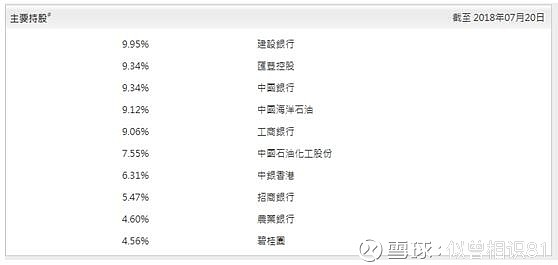
The index currently accounts for 70.53% of financial real estate, 17.04% of energy, and 7.89% of optional consumption, focusing on traditional cyclical industries, with a current dividend yield of 4.78%.
The fund rose 8.79% in 2014, fell 7.65% in 2015, fell 1.22% in 2016, and rose 48.42% in 2017.