About 2.2 billion people (more than a quarter of the world’s population) do not have access to safe, managed drinking water, and about half of the world’s population experiences severe water shortages at some time of the year. To overcome these shortages, huge social and economic costs are being spent on sewer irrigation and alternative water sources such as rainwater reuse and desalination.
In addition, the disadvantage of these centralized water distribution systems is that they cannot immediately respond to changes in water demand. As a result, there is growing interest in decentralized water production technologies, which are electrochemically-based technologies that are easy to adopt, such as capacitive deionization and battery electrode deionization (also known as Faraday deionization).
However, existing water quality measurement sensors based on electrochemical technology cannot measure and track individual ions in water and have limitations in roughly inferring water quality conditions based on conductivity.
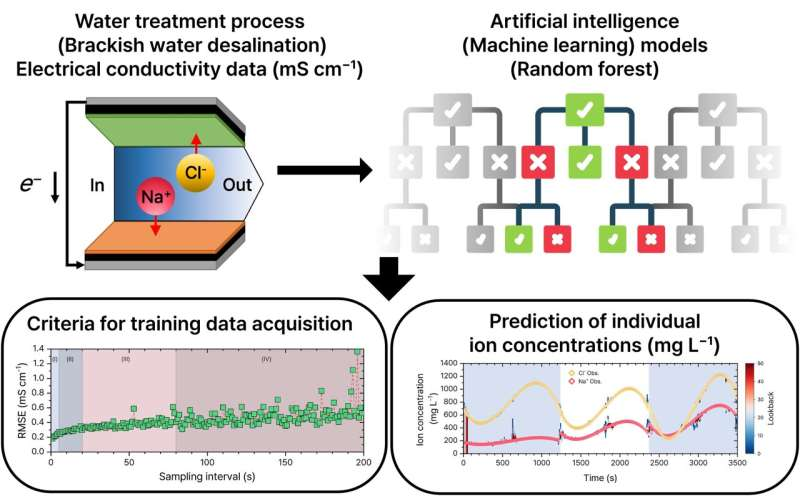
The research team of Dr. Son Moon from the Water Cycle Research Center of the Korea Institute of Science and Technology (KIST) collaborated with the team of Professor Baek Sang-Soo from Lingnan University to develop a technology that uses data-driven artificial intelligence to accurately predict electrochemical water treatment. The concentration of ions in water during the process.
Their paper was published in the journal Water Research.
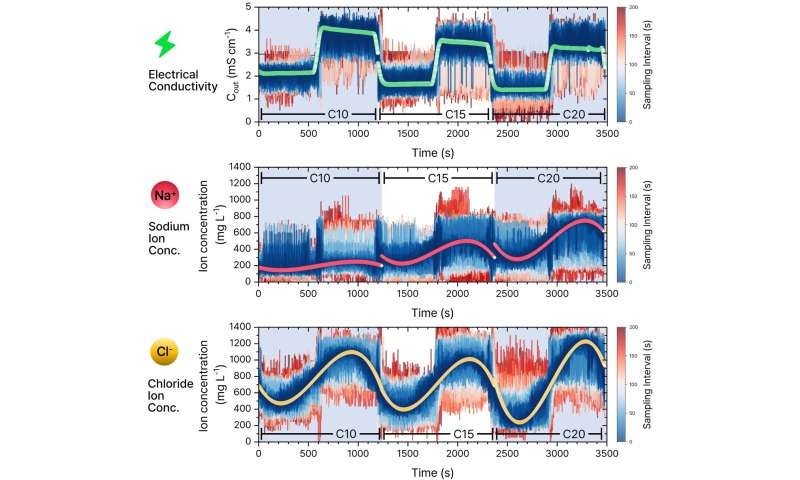
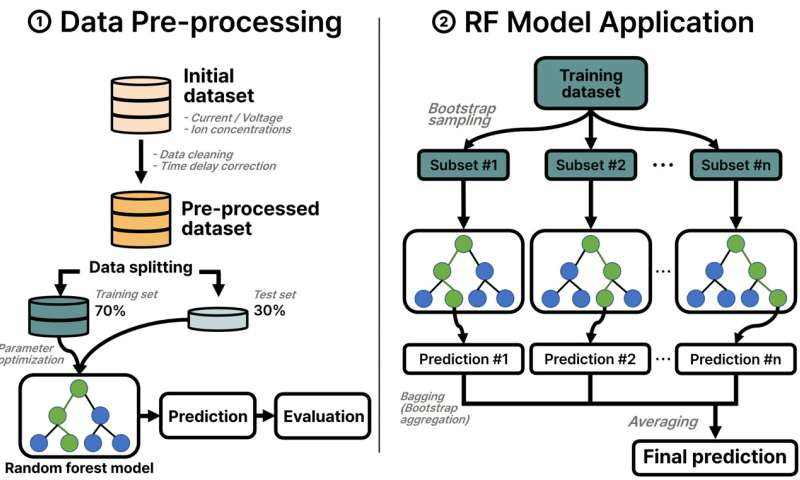
The researchers first built the random forest model, a tree-based machine learning technique used for regression problems, and then applied it to predict ion concentrations in electrochemical water treatment technology.
The developed artificial intelligence model based on random forests is able to accurately predict the conductivity of treated water and the concentration of each ion (examples of sodium ions, potassium ions, calcium ions, and chlorine)(R2 =~0.9).
They also found that updates were needed approximately every 20-80 seconds to improve the accuracy of predictions, which means that in order to apply the technology to the national water quality network to track specific ions, it would be necessary to measure water quality at least once in a while. Train the initial model in minutes.
The advantage of the random forest model used in this study is that it is economically superior to complex deep learning models, and the computing resources required for training are reduced by more than 100 times.
Dr. Moon said: “The significance of this research is not only to develop new artificial intelligence models, but also to apply them to the national water quality management system.” “Through this technology, the concentration of individual ions can be monitored more accurately, helping to improve social water welfare.”
There are links in the video below this video. If you are interested, you can open it and have a look.
Thank you for watching this video. If you like it, please subscribe and like it. thank
Original text:https://techxplore.com/news/2024-09-artificial-intelligence.html
More information: Hoo Hugo Kim et al., Using artificial intelligence models to decouple ion concentrations from wastewater conductivity curves in capacitor and battery electrode deionization, Water Research (2024). DOI:10.1016/j.watres.2024.122092
Journal Information: Water Research
Oil tubing: