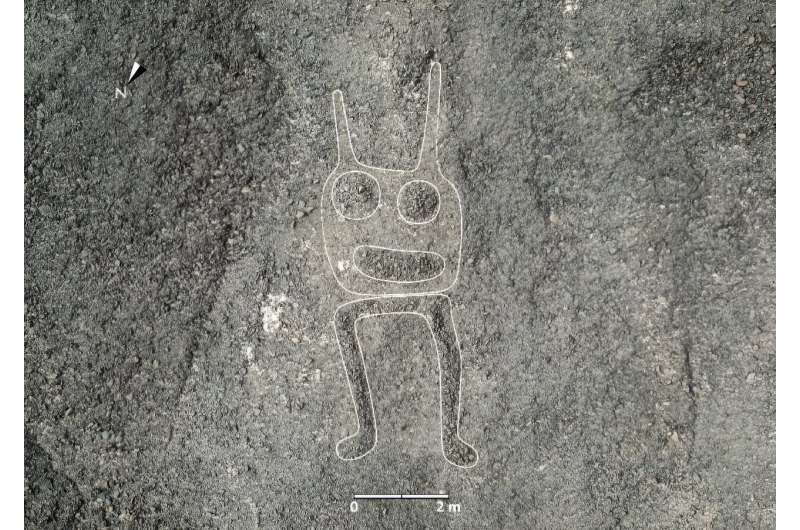
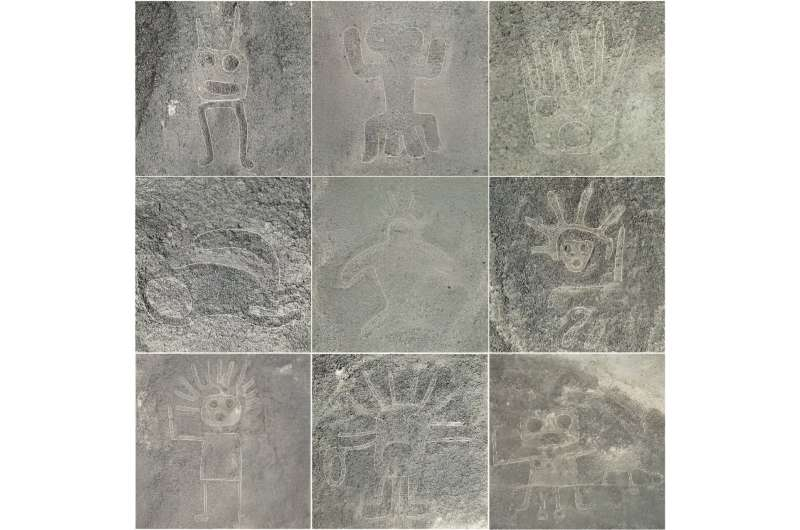
Japanese scientists have used artificial intelligence to discover 303 new etchings in the Nazca Desert in Peru, doubling the number of geological symbols known to the Inca civilization about 2,000 years ago.
The legendary Nazca lines are a series of huge incisions in the desert floor that depict animals, plants, imaginary creatures and geometric shapes that have fascinated scientists since they were first discovered about a century ago.
Located about 220 miles (350 kilometers) south of Lima, the line is one of Peru’s most popular tourist attractions and is best viewed from the air.
“Using artificial intelligence in research allows us to map the distribution of geographical symbols in a faster and more accurate way,” said Masahito Sakai, an archaeologist at Yamagata University who announced the new discovery in Lima on Monday.
He said the findings were the result of a collaboration between his university’s Nazca Institute and technology company IBM Research.
He added: “Traditional research methods involve visual identification of geographical symbols from high-resolution images of this vast area, which is slow and has the potential to ignore some of them.”
The study, also published Monday in the prestigious journal Proceedings of the National Academy of Sciences (PNAS), describes how artificial intelligence can be used to accelerate archaeological discoveries, even in well-known sites.
The newspaper said it took nearly a century to discover 430 symbolic Nazca land paintings.
Using artificial intelligence, scientists discovered more than 303 viruses in just six months of field investigation.
Artificial intelligence models are particularly good at recognizing smaller embossed ground paintings that are more difficult to detect with the naked eye.
Among the newly discovered figures are huge linear ground paintings, mainly representing wild animals, but there are also smaller ground paintings with patterns of abstract humanoid animals and domesticated camelids.
Scientists use artificial intelligence to analyze large amounts of geospatial data generated by aircraft to identify areas where more geographical symbols may be found.
The people who formed the Nazca civilization lived in southwestern Peru from 200 BC to 700 AD.
What prompted them to build these routes, which are listed as a World Heritage Site by UNESCO, remains a mystery.
Some scientists believe they have astrological and religious significance.
The first geological symbol was discovered in 1927.
There are links in the video below this video. If you are interested, you can open it and have a look.
Thank you for watching this video. If you like it, please subscribe and like it. thank
Original text:https://techxplore.com/news/2024-09-ai-uncovers-ancient-etchings-peru.html
More information: Masato Sakai et al., AI-accelerated NASCAR survey nearly doubled the number of known metaphors and clarified its purpose, Proceedings of the National Academy of Sciences (2024). DOI:10.1073/pnas.2407652121
Journal Information: Proceedings of the National Academy of Sciences
Oil tubing: