Recent technological advances have made possible the development of various electronic devices designed to improve people’s quality of life and help them complete daily activities. Most existing devices are operated through touchscreens, keyboards, mouse pads and other manual interfaces.
Researchers at the National University of Singapore have developed a smart tooth guard that allows people to operate the device with their mouth rather than their fingers. A paper in the journal Nature Electronics describes the new device, which also allows dentists to collect medical data from patients ‘mouths and help monitor athletes’ recovery or improve their performance.
“The inspiration for our paper came from the need to develop more intuitive and easy-to-use assistive technologies for individuals with reduced mobility,” Liu Xiaogang, the paper’s supervising author, told Tech Xplore.
“Traditional input devices, such as touch screens or voice recognition, are often challenging in certain environments or for users with limited hand capabilities. Our goal is to develop a more flexible, user-friendly interface that can be manipulated using the tongue and teeth, which allows precise and fatigue-free movements.”
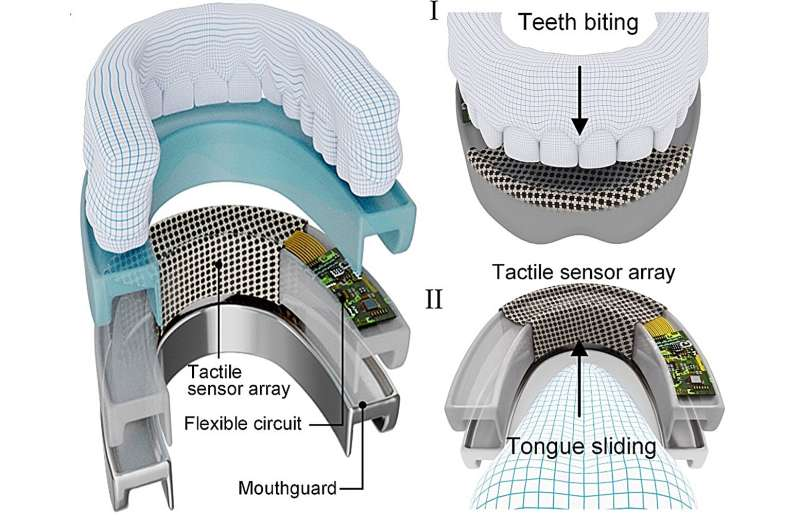
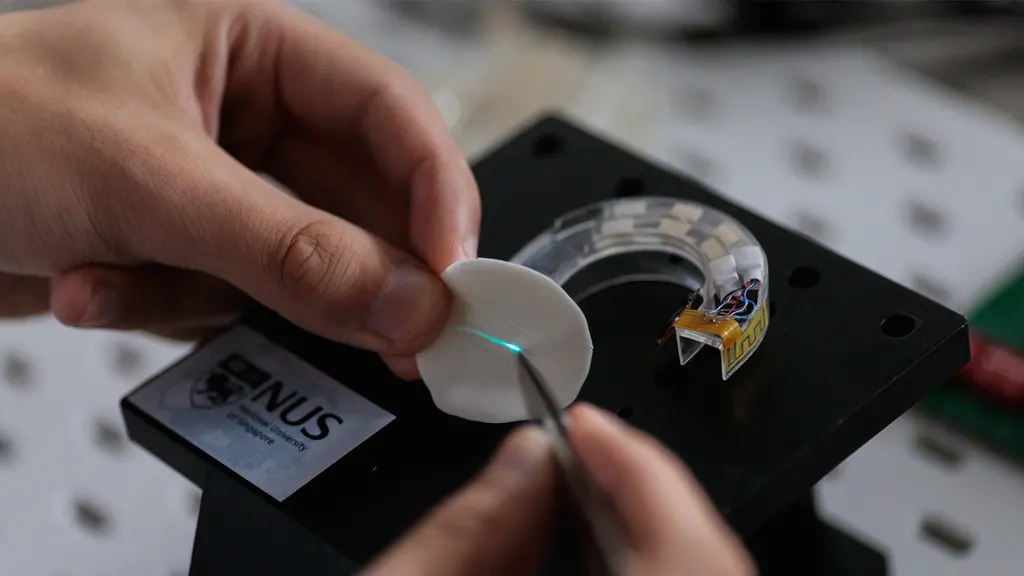
The main goal of Liu and his colleagues ‘recent research is to address the limitations of existing human-machine interfaces by creating an adaptable, mouth-based wearable device that is minimally invasive but can effectively allow users to control their devices in the environment. Various complex ways. This idea led to the development of a tactile oral pad (O-pad) with an embedded tactile sensor array, flexible circuit and artificial intelligence integration.
The smart tooth guard they designed is equipped with soft and sensitive sensors. These sensors allow users to process a variety of tasks, including typing, gaming and wheelchair navigation, through the movement of their tongue and teeth, rather than tapping or swiping their fingers on the touch screen.
“The wearable tactile oral pad we have developed has similar functions to touch screens such as i-Pad, but can be controlled through tongue movement and teeth biting,” Liu explained.
“It consists of a carbon nanotube-silicone composite sensor array embedded in a flexible biocompatible pad that fits into the mouth. When the tongue slides on the pad, it mimics the movement of a finger sliding on the touch screen, and when the teeth are bitten down, it mimics the movement of a finger sliding on the touch screen. On the mat, it acts like a mouse click.”
The wearable device developed by the researchers detects the sliding movement of the tongue and the pressure exerted by the teeth through a series of sensors. The device is also lightweight, flexible and cost-effective, which can facilitate its commercialization and practical deployment.
“Our device can achieve complex controls through the movement of the tongue and teeth,” Liu said.
“This dual-action feature allows users to perform tasks such as typing, gaming and wheelchair navigation with high precision and ease. The use of recurrent neural networks (RNNs) further enhances the device’s ability to recognize patterns, allowing it to efficiently translate tongue and tooth movements into precise control commands.”
The smart tooth guard launched by Liu and his colleagues may have widespread applications. Most notably, it allows people with physical disabilities to interact easily and intuitively with electronic devices, for example, allowing them to write text messages, answer calls, operate wheelchairs or browse the web independently.
“It can also find application in environments where traditional input methods are impractical, such as sterile surgical environments or where the risk of contamination is high,” Liu said.
The team’s tactile O-pad can also be used in dentistry to help monitor teeth, as well as speech therapy and sports, which can be used to track recovery or test exercise coordination. Finally, the device can implement a new form of biometrics that allows users to safely access their device or account using their teeth.
“Looking forward, we plan to further optimize the tactile oral pad to accommodate a wider range of applications by improving its sensor array to accommodate more complex movements,” Liu added.
“We also aim to improve the comfort and wearability of the device for long-term use and explore its potential in areas such as prosthetic control and robotics. Finally, we plan to conduct more extensive clinical trials to assess its usability and effectiveness in real-world settings, especially for people with severe movement disorders.”
There are links in the video below this video. If you are interested, you can open it and have a look.
Thank you for watching this video. If you like it, please subscribe and like it. thank
Original text:https://techxplore.com/news/2024-09-smart-mouthguard-users-devices-tongue.html
More information: Bo Hou et al., Carbon nanotube-based tactile oral pads for multimodal tactile interactions, Nature Electronics (2024). DOI:10.1038/s41928-024-01234-9 。
Journal information: Nature Electronics
Oil tubing: