This article is translated from the original:
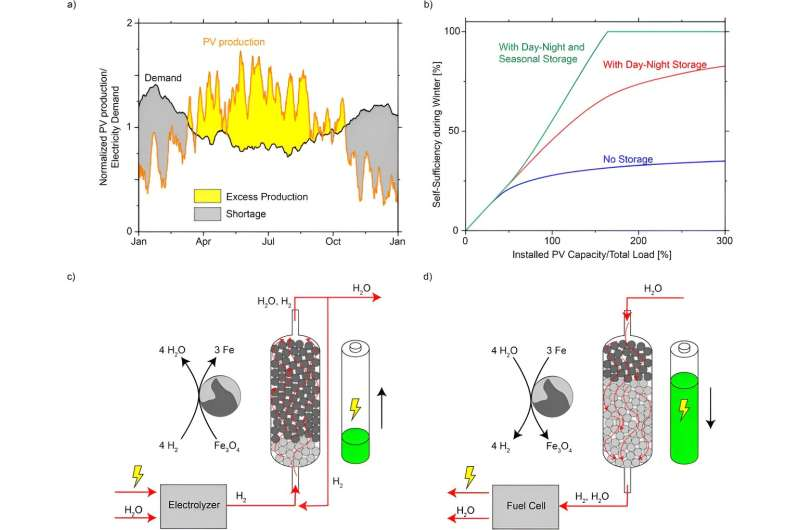
By 2050, photovoltaic power generation is expected to meet more than 40% of Switzerland’s electricity needs. But solar energy is not always available when needed: there is too much solar energy in summer and too little solar energy in winter, when there is less sunlight and heat pumps cannot be used. Run at full speed. Under the Swiss federal government’s energy strategy, Switzerland hopes to close the winter power gap through a combination of imports, wind and hydropower, and alpine solar and gas-fired power plants.
One way to minimize the need for imports and gas-fired power plants in the winter is to use cheap solar energy to produce hydrogen in the summer and then convert it into electricity in the winter. However, hydrogen is highly flammable, highly volatile, and makes many materials brittle.
Storage of gas from summer to winter requires special pressurized vessels and cooling technology. These require a lot of energy, and the many safety precautions that must be followed make building such storage facilities very expensive. What’s more, hydrogen tanks are never completely leak-proof, which can damage the environment and increase costs.
Now, researchers led by Wendelin Stark, professor of functional materials in the Department of Chemical and Applied Biosciences at ETH Zurich, have developed a new technology for seasonal storage of hydrogen that is safer and cheaper than existing solutions. Researchers are using a well-known technique and the fourth most abundant element on earth: iron.
The research results were published in the journal Sustainable Energy and Fuels.
chemical storage
To better store hydrogen, Stark and his team used a steam ironing process known since the 19th century. If there is excess solar energy in summer, it can be used to decompose water to produce hydrogen. Hydrogen is then fed into a stainless steel reactor filled with natural iron ore at 400 degrees Celsius. There, hydrogen extracts oxygen from iron ore (in chemical terms for iron oxide), producing the elements iron and water.
“This chemical process is similar to charging a battery. This means that the energy in hydrogen can be stored for long periods of time in the form of iron and water with little loss,”Stark said.
When energy was needed again in winter, the researchers reversed the process: They injected hot steam into the reactor, reconverting iron and water into iron oxide and hydrogen. The hydrogen can then be converted into electricity or heat in a gas turbine or fuel cell. In order to keep the energy required for the discharge process to a minimum, waste heat from the discharge reaction is used to produce steam.
Cheap iron ore meets expensive hydrogen
“One of the great advantages of this technology is that the raw material iron ore is easy to purchase in large quantities. And, it doesn’t even need to be processed before we put it into the reactor,”Stark said. In addition, researchers believe that large iron ore storage facilities can be built around the world without significantly affecting global iron market prices.
The reactor in which the reaction takes place does not have to meet any special safety requirements. It consists of stainless steel walls only 6 mm thick. The reaction is carried out at atmospheric pressure and the storage capacity increases with each cycle.
Once filled with iron oxide, the reactor can be reused for any number of storage cycles without replacing its contents. Another advantage of this technology is that researchers can easily expand storage capacity. This is just a case of building a larger reactor and filling it with more iron ore. All of these advantages make this storage technology ten times cheaper than existing methods.
However, using hydrogen also has a disadvantage: its production and conversion efficiency is lower compared to other energy sources, because up to 60% of energy is lost in the process. This means that hydrogen is most attractive as a storage medium when there is enough wind or solar energy and other options are not feasible. This is especially true for industrial processes that cannot be electrified.
For more content, you can click on the link below the video
Thank you for watching this video. If you like it, please subscribe and like it. thank
Original text:https://techxplore.com/news/2024-08-iron-based-hydrogen-storage-feasibility.html
Oil tubing: