In March 2020, a large-scale 10-year study led by the National Institutes of Health (NIH), the National Cancer Institute (NCI), the National Institute on Aging (NIA), and the Centers for Disease Control and Prevention (CDC) was published in the world-renowned medical journal JAMA (Journal of the American Medical Association). ①
JAMA
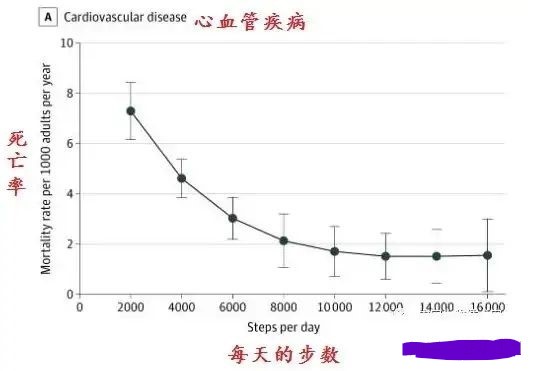
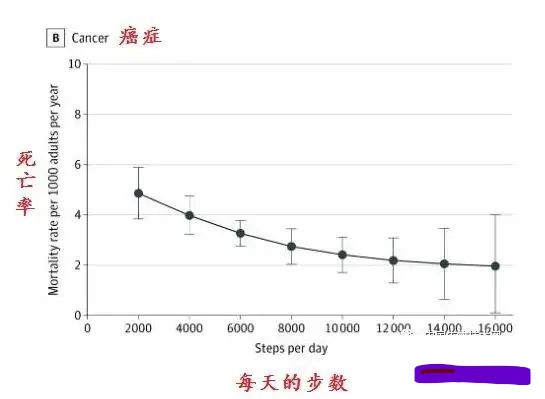
Between 2003~2006, researchers followed a representative sample of 4,840 adults over the age of 40 in the United States for 10 years. A total of 1165 participants died over the course of 10 years of follow-up, of which 406 died from cardiovascular disease and 283 from cancer.

Picture from: JAMA
The results of the study found that there was a very significant quantitative correlation between more daily walking steps and lower all-cause, cardiovascular and cancer mortality!
- Walking < 4000 steps/day: 655 participants with a mortality rate of 76.7/1000 per year, with a total of 419 participants dying over 10 years.
- Walking 4000~7999 steps/day: 1727 participants, with a mortality rate of 21.4/1000 per year, and a total of 488 participants died within 10 years.
- Walking 8000~11999 steps/day: 1539 participants, with a mortality rate of 6.9/1000 per year, and a total of 176 participants died within 10 years.
- Walking > 12000 steps/day: 919 participants, mortality rate of only 4.8/1000 per year, a total of 82 deaths over 10 years.
Ultimately, the results illustrate three major issues:
1. Normal people: Try to take 8,000-12,000 steps a day is optimal
Compared to those who walked 4,000 steps a day, those who walked 8,000 steps a day had a 51% lower risk of all-cause mortality, while those who walked 12,000 steps a day had a 65% lower risk of all-cause mortality. and when it reaches 14,000 steps or 16,000 steps, the risk of all-cause death will basically not be reduced.
2. Sedentary people: Just a little exercise every day can have significant benefits
If the daily number of steps can be increased from 2,000 to 4,000 steps, the total mortality rate will decline the most in this range. Therefore, if people who are basically inactive every day can increase the number of daily steps from 2,000 to 4,000, there will be significant benefits.
3. Chronic disease population: Cardiovascular disease and cancer mortality rates have decreased
Participants who took 8,000 steps a day had a significant reduction in cardiovascular disease and cancer mortality compared to 4,000 steps a day.
In addition to the number of steps you take, how to walk, there is also a need to pay attention to it:
Many people walk wrong!
1. Walking in the wrong place: Love walks on the side of the road
Walking and fitness, where to go, is very important! If the location is not chosen well, it may be harmful to the body.
On December 5, 2017, the top international medical journal “The Lancet” published a study showing that regardless of whether they were healthy or not, volunteers walking in the park had improved lung function and arterial vascular softening significantly, while those who walked along the street had weak lung function improvement and even worsened arteriosclerosis. ②
Professor Li Jing of the Sports Health Consultation Clinic of Nanjing Hospital of Integrated Traditional Chinese and Western Medicine explained in an interview with Health Times in 2017 that the street is a place with serious air pollution, and vehicles coming and going will emit a lot of harmful gases such as carbon monoxide, hydrocarbons, nitrogen oxides, and sulfur dioxide. Breathing will deepen and speed up during exercise, and if the environment during exercise is relatively dirty, it will definitely be harmful to the body after inhalation. ③
2. Wrong walking posture: bow your head and hunched over
If you “hunched over” when walking, in the long run, not only will you not achieve a good exercise effect, but it will lead to soft tissue damage.
Deng Jingyuan, director of the Department of Encephalology of the Rehabilitation Center of the First Affiliated Hospital of Xi’an Jiaotong University, explained in an article published in the Health Times in 2008 that when walking with your head held high, the seven meridians and eight meridians of the whole body move together, and the walking posture with the chest and bending over will make the meridians not relax well and the body will not get the oxygen supply it deserves. The curvature of the spine will also reflect to the brain, putting people in a state of tension, causing brain overwork and affecting night’s sleep. ④
3. Wrong preparation for walking: Do not warm up before walking
Many people feel that walking does not exercise much, so they often ignore the warm-up activities before walking.
Bai Liqun, chief physician of the Department of Orthopedics of the Oriental Hospital Affiliated to Beijing University of Traditional Chinese Medicine, said in an article in the Health Times in 2014 that one of the most common reasons for many sports injuries is that they have not made preparations such as warm-up exercises. In this way, the body suddenly and quickly enters a state of movement, and it is easy to overwhelm it. ⑤
In addition, if you don’t warm up, your joints will not open, your movement will be limited, and your exercise will not be effective.
4. Wrong walking time: Walk before dawn
Many people who insist on morning exercise choose to go for a walk before the sun comes out, thinking that they will not be exposed to the sun at this time, and can breathe relatively fresh and oxygenated air. In fact, exercising at this time is not conducive to physical health.
Liu Gang of the Department of Rehabilitation Medicine of the Third Affiliated Hospital of Southern Medical University explained in an article in the Health Times in 2013 that because plant chlorophyll can only be photosynthesized with the participation of sunlight, there is no sunlight on the leaves before sunrise, and there is no photosynthesis overnight near the plant, instead of fresh oxygen, a large amount of carbon dioxide is accumulated, which is not conducive to good health. ⑥
5. Wrong timing of walking: Leave immediately after eating
As the saying goes, if you walk a hundred steps after eating, you will live to ninety-nine. But this sentence may convey a false concept, especially for patients with coronary heart disease, walking 100 steps after eating may also lead to danger.
Yang Feiyan, deputy chief physician of the Department of Cardiovascular Medicine of Wuhan Central Hospital, explained in an article in the Health Times in 2017 that because after a full meal, especially after a high-protein and high-fat diet, the blood will be more concentrated in the gastrointestinal tract to strengthen digestive function. ⑦
Therefore, everyone is reminded that they should rest for half an hour to an hour after eating before exercising, especially those with coronary heart disease.