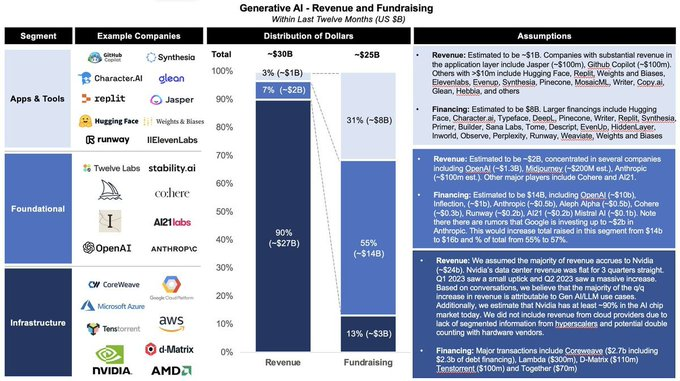
Check out this graph showing the distribution of revenue/fundraising funds in generative AI
In summary:
- Despite only 13% of venture capital being received, the vast majority of revenue is captured by infrastructure companies.
- Most of the financing goes to model and app companies, even though they only account for 10% of revenue.
Some questions to think about:
1️⃣ Why does this dichotomy exist?
The main reason is that Gen AI is still in its early stages. Similar patterns have been seen throughout history, with development and monetization in the infrastructure sector preceding the application sector. For example, internet infrastructure precedes internet applications such as search and e-commerce.
### 2️⃣ Will this pattern change soon?
I expect the current income distribution to maintain its current pattern in the short term. Although we may observe some growth in the model and application/tool space due to the small starting base, it is unlikely to catch up with the infrastructure space. Nvidia’s data center revenue alone is expected to double to $40B next year. In addition, as long as Nvidia continues to maintain its monopoly, infrastructure/chip prices will remain high. Finally, most of the computation we currently have is allocated to the training side – we haven’t seen a major expansion on the inference side yet. For all these reasons, I expect infrastructure to remain the main revenue engine for the foreseeable future.
### 3️⃣ What will the final state look like?
In the long run, I expect the TAM for the application and modeling stack to be 2-4 times larger than the infrastructure stack. If we look at more established industries like SaaS, gross margins are typically around 70-90%, with most of the COG going to cloud hosting costs. One could argue that native generative AI companies need to have a similar profit profile.
### 4️⃣ What happens to fundraising?
Considering that up to 80% of the money raised by foundation model companies is spent on computing, I expect the scale of the model’s fundraising to be directly proportional to infrastructure revenue. However, the application/tool space can be more volatile, depending on whether the company can grow to its valuation. It depends on how quickly businesses adopt generative AI solutions, which are still in their infancy.
In short, the only donor to generative AI over the past 12 months seems to be Nvidia. While this won’t last forever, a major shift will take time.
Source: Kelvin Mu
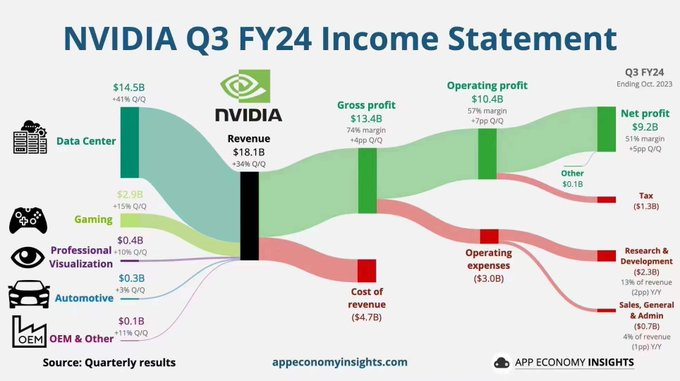
Supplement an Nvidia Q3 income, or make money,
18.1 billion total revenue, 14.5 billion data center revenue, and 9.2 billion net profit.