Should the Schwab U.S. Dividend Equity ETF (SCHD) be on your investment radar?
Zacks Stock Research
Tuesday, May 3, 2022, 7:20 p.m. · 4 min read

Want broad exposure to large-cap value stocks in the U.S. stock market? You should consider the Schwab U.S. Dividend Equity ETF (SCHD), a passively managed exchange-traded fund launched on October 20, 2011.
The fund is sponsored by Charles Schwab. It has amassed over $342.7M in assets, making it one of the largest ETFs trying to match the broader market value sector of the U.S. stock market.
Why the market is valuable
Large-cap companies typically have a market capitalization of more than $100M. Overall, they are generally a stable option with less risk and more reliable cash flow compared to small and medium-sized companies.
With below-average P/E and P/B ratios, value stocks also have below-average sales and earnings growth. While value stocks outperform growth stocks in almost all markets in terms of long-term performance, growth stocks are more likely to outperform value stocks in a strong bull market.
Fees
Cost is an important factor in choosing the right ETF, and if all other fundamentals are equal, a cheaper fund can significantly outperform its more expensive peers.
The ETF has an annual operating fee of 0.06%, making it one of the cheapest in the space.
It has a 12-month trailing dividend yield of 2.98%.
The sector has the largest exposure and shareholding
ETFs provide diversified exposure, thereby minimizing the risk of individual stocks, but it’s still important to delve into the fund’s holdings before investing. Most ETFs are very transparent products, and many disclose their holdings on a daily basis.
The ETF has the heaviest allocation to the information technology sector – about 20.10% of the portfolio. Finance and consumer staples are in the top three.
In terms of individual holdings, Amgen Corporation (AMGN) accounts for approximately 4.47% of total assets, followed by Coca-Cola (KO) and Verizon Communications (VZ).
The top 10 holdings account for approximately 41.04% of total assets under management.
Performance and risk
SCHD seeks to match the performance of the Dow Jones US Dividend 100 before fees and expenses. The Dow Jones US Dividend 100 Index measures the performance of high-dividend-yielding stocks issued by U.S. companies with a track record of consistently paying dividends, choosing fundamental strength relative to their peers based on financial ratios.
The ETF has fallen by about -5.40% so far this year and is up about 4.92% over the past year (as of May 3, 2022). Over the last 52 weeks, it has traded between $73.97 and $81.94.
The ETF has a beta of 0.92 with a standard deviation of 22.68% over the last three years, making it a moderately risky option in the space. It has approximately 105 types of shares, effectively spreading company-specific risks.
Alternatives
Schwab US Dividend Equity ETF has a Zacks ETF Rank of 3 (Hold), which is based on factors such as expected asset class returns, expense ratio, and momentum. Therefore, SCHD is a reasonable choice for those seeking exposure to the Style Box – Large-Cap Value Market segment. Investors may also want to consider some other ETF options in this space.
The iShares Russell 1000 Value ETF (IWD) and Vanguard Value ETF (VTV) track similar indices. The iShares Russell 1000 Value ETF has $537M in assets, while the Vanguard Value ETF has $977.6M. IWD has an expense ratio of 0.19% and VTV has an expense ratio of 0.04%.
The bottom line
Retail and institutional investors are increasingly turning to passively managed ETFs because they offer low costs, transparency, flexibility, and tax efficiency; These funds are also a great tool for long-term investors.
To learn more about this and other ETFs, screen products that align with your investment goals and read articles on the latest developments in the ETF investment space, visit the Zacks ETF Center.
SCHD: Building a solid foundation for the upcoming storm
April 15, 2022 at 2:45 PM ET Schwab Strategic Trust – Schwab US Dividend Equity ETF (SCHD) 11 Comments5 Likes
97 followers
Follow
Summary
- For macro events like upcoming interest rate hikes and subsequent recessions, SCHD is a safe hold.
- The fund has performed well in the face of interest rate hikes due to its large positions in large-cap stocks and financial assets that can be profited from.
- The fund will perform well during a recession as it is currently reasonably valued, with nearly 30% positions in dividend champions and aristocrats and a debt/EBITDA of 2.
Introduction
In the first quarter of 2022, investors invested in the Schwab US Dividend Equity ETF (NYSEARCA: SCHD ) invested a lot of money— More than the sum of funds related to the S&P, Dow Jones and Nasdaq. But is the investment community positioning itself correctly, about this ETF, about the macro headwinds that will accelerate in the second half of the year? After all, your name is trader, and we’ve seen communities recently start pouring into thematic ETFs like the ARK Innovation ETF ( ARKK ), pushing them into bubble territory and then eventually moving on to the next big event, allowing them to shrink back into value territory in classic market dynamics.
However, at this time of year, I believe traders are right about HODL – that is, to stay the course – this fund for the following reasons:
The Fed and interest rate hikes are related:
- It has performed well under the most recent series of rate hikes (2016 to 2019).
- It outperformed the broader market slightly during the 2018 rate hike/tapering scare and is currently doing better in the current situation.
- In a high-interest rate environment, value tends to outperform growth.
- It has about 20% of its position in the lowest-valued finance-related stocks in all 11 industries, second only to the 2008 trauma, and will also benefit from higher interest rates.
Recession related:
- The fund is currently reasonably valued (while the S&P continues to be overvalued).
- By weight, dividend champions and aristocrats make up nearly 30% of the fund’s shares.
- During a recession, value tends to perform well relative to growth (i.e., the tech-heavy S&P 500), especially when commodity prices and short-term Treasury yields (federal funds rate) tend to move higher.
- Using my weighted average formula (which takes into account the relative weighting of each holding), it has an above-average expert focus on safety score and low debt to E.
For those looking for earnings and dividend growth, SCHD is now a solid choice. This is a classic ETF with a fair price.
How does the rate hike affect SCHD?
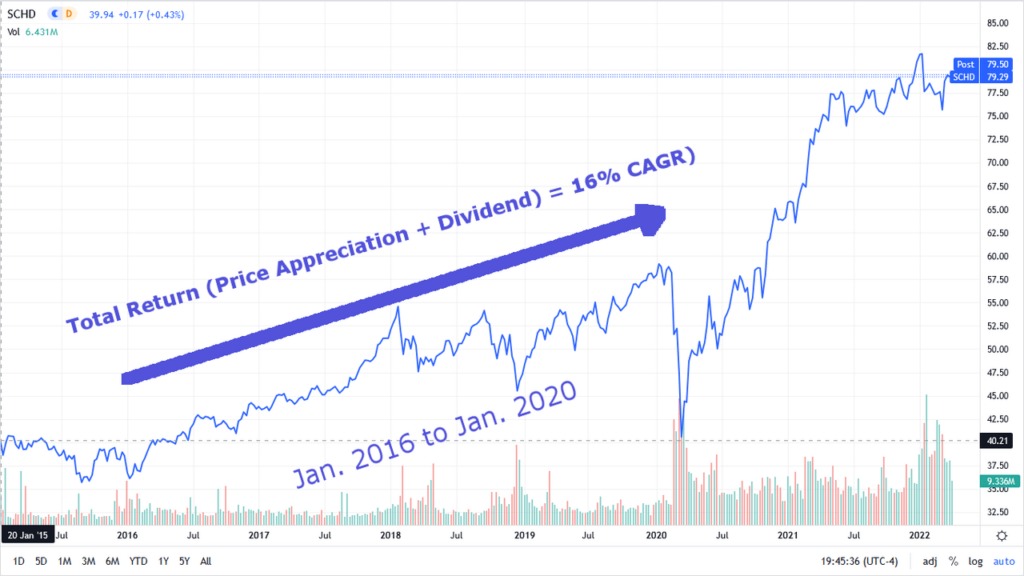
During the 2016-2019 rate hike, SCHD did what it was supposed to do: it gave up the safe 3-handle yield, raised its dividend to a CAGR of 8.1%, and gained some appreciation in the process, with a total return of 16% CAGR. This is in a low-inflation environment, where everyone is focused on growth, and the Invesco QQQ ETF ( QQQ) and even the highly technical SPDR S&P 500 Trust ETF ( SPY ) are suitable choices.
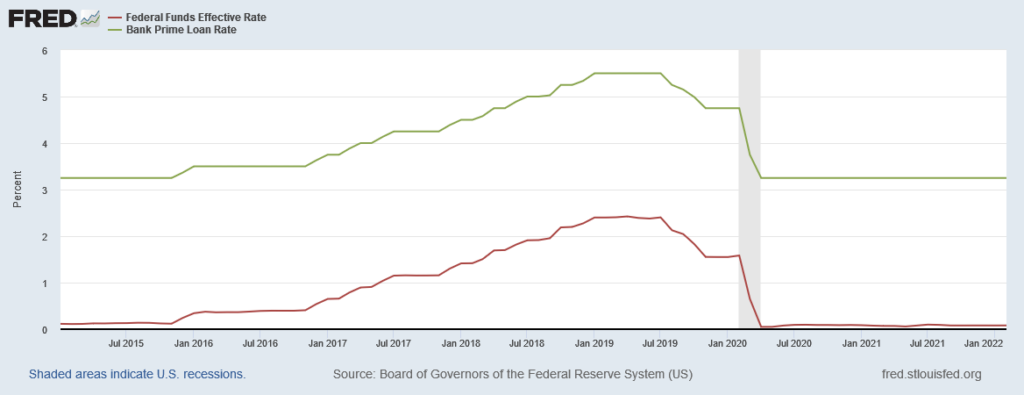
St. Louis Fed
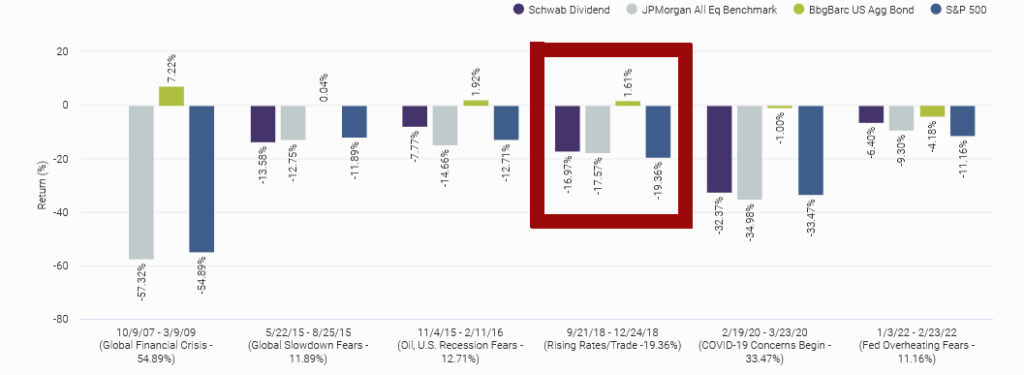
In fact, during the tapering panic from Q4 2018 to Q2 2019, SCHD retraced slightly better than the broader market when traders were not enthusiastic about rate hikes and the concomitant quantitative tightening:
JPMorgan Asset Management
Incidentally, it’s worth noting that four of the five stress tests listed by JPMorgan Chase & Co. show that SCHD is performing at least slightly better than the broader market. The latest set of data (1/3/22 – 23/22) shows that SCHD is significantly less affected by inflation and rate hike sentiment.
In a rate hike environment, value outperforms growth
At this point, I might preach to the choir, but just in case you’re new, capital tends to shift from growth to value at the start of the rate hike series and can last up to 18 months into the campaign.
S&P Global explains how the increase in interest rates and the cost of capital is putting downward pressure on discounted cash flow calculations:
Higher interest rates reduce the value of a company’s future cash flows and their overall value today. This could be bad news for growth stocks (defined by metrics such as sales growth) that are expected to see greater returns in the future. At the same time, high-interest rate environments tend to have less impact on value stocks like financials and energy, as these companies are often defined by their ability to generate profits today.
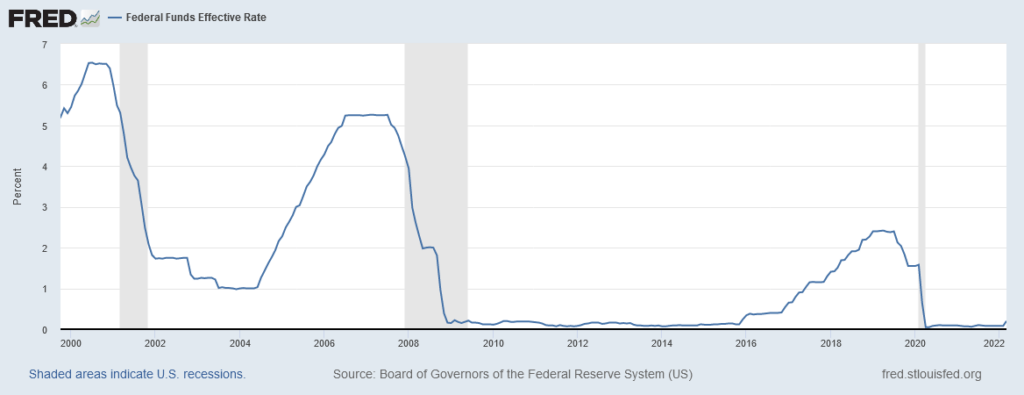
We can look at the iShares S&P 500 Value ETF (IVE) vs. the iShares S&P Growth ETF (IVW) in action in the early 2000s, before the bankers knocked us down:
Conclusion
For the capital flowing into SCHD, traders are currently rational actors. It will become a haven from future macro storms Hong Kong stock dividend ETFs. It’s a solid hold, but if these headwinds push it down to the 4% yield zone, I’d consider increasing my position myself.
This article was written by Andrew Fitzeller
Andrewfez provides mathematical-driven insights into value-related investing. He is the author of the book, How to Calculate How Much You Overpaid for Your Home During or After a Real Estate Bubble: A Guide to Quantifying Short, Medium, and Long-Term Losses, written under his pseudonym Thomas Smyth. Another niche area he cares about is calculating the fair value of ETFs and mutual funds using his proprietary weighting formula. Andrewfez is also a classical music composer, healthcare professional, woodworker, Airbnb host, and occasional fiction and non-fiction writer.
Disclosure: I/we hold favorable long positions in SCHD’s shares through stock ownership, options, or other derivative instruments. I wrote this article myself, and it expresses my own opinion. I didn’t receive compensation (except for Seeking Alpha). I have no business relationship with any of the companies whose shares are mentioned in this article.