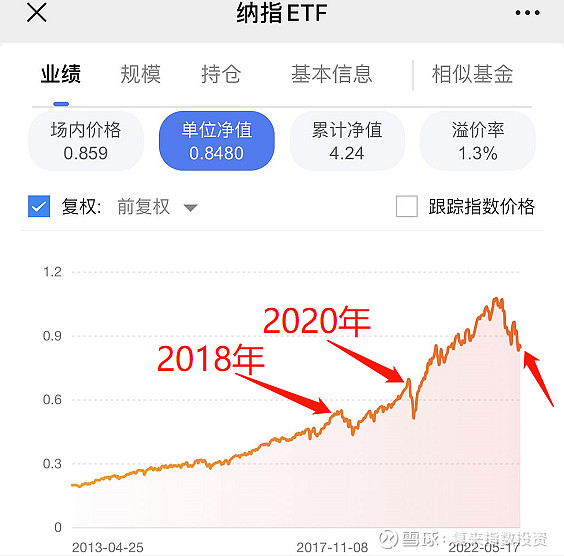
Nasdaq ETF (513100.SH), is a fund with excellent historical investment returns, since its establishment in April 2013, the cumulative increase in compounding is 330.8%, the annualized increase is 17.5%, and more importantly, the net value trend of this ETF is very stable, and the holding experience is very good
If you look at the comprehensive income risk performance, the Nasdaq ETF is enough to outperform 99% or even all index funds and active funds in the A-share market during the same period.
Judging from the net value trend chart of Nasdaq ETFs, since 2013, there have been three time periods with a large drawdown, with a maximum drawdown of 22% in 2018, a maximum drawdown of 28% in 2020, and a maximum drawdown of 30% this year.
The first two retracements were a very good buying point in hindsight, and the maximum drawdown of this wave has exceeded the first two waves, does it also correspond to a very good buying point? This is the most important concern for us as investors right now.
In order to understand this question, let’s first understand what kind of fund the Nasdaq ETF is.
1. Introduction to the index
Nasdaq ETF (513100.SH), the index tracked is: Nasdaq 100 Index (NDX. GI)。
The Nasdaq 100 index is composed of the 100 largest non-financial companies in the Nasdaq market in the United States, which are mainly technology leaders in high-growth industries such as information technology, consumption, retail and wholesale trade and biotechnology.
Specifically, the weighted stocks of the Nasdaq 100 include: Apple (11.42%), Microsoft (9.23%), Google (3.53%+3.33%), Amazon (6.59%), Tesla (4.31%), Nvidia (3.83%), Meta Platforms (3.14%), etc.
Nasdaq 100 weighted stocks:
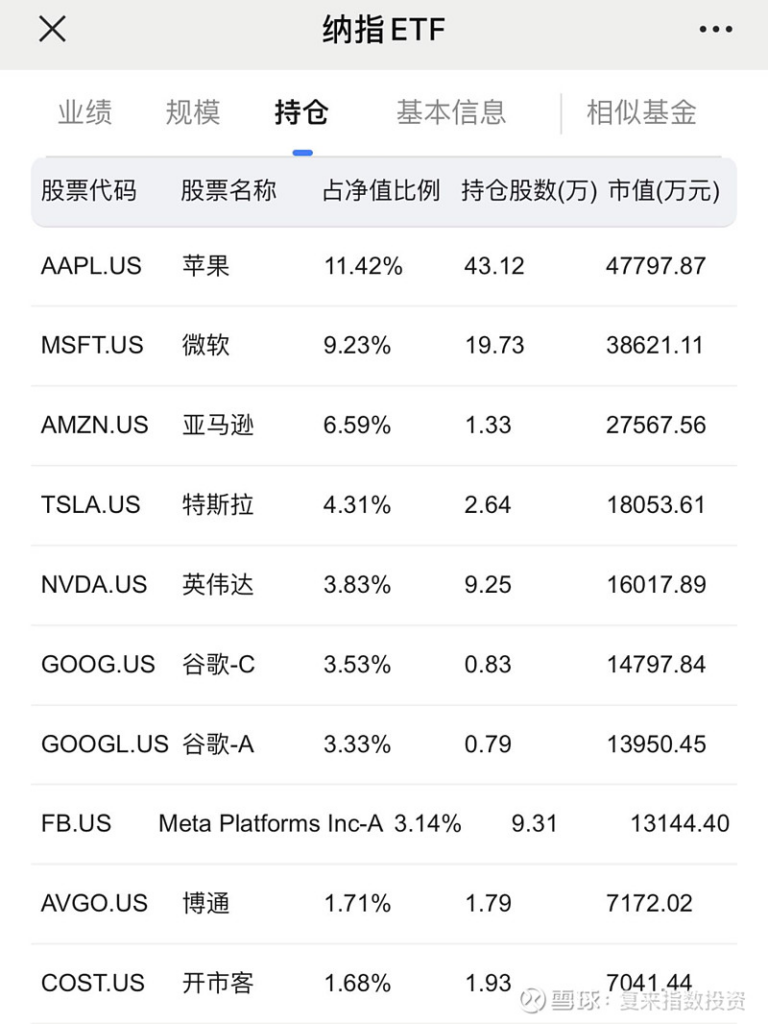
Note: Here I use the fund holdings of the Nasdaq ETF to approximately replace the index constituents
These companies are basically well-known global “leaders” in their respective tracks, with huge size and obvious first-mover advantage, and their industry position is difficult to shake.
Overall, the Nasdaq 100 index is characterized by high technology, high growth and non-financial.
Here is a special mention of the Nasdaq 100 Index (NDX. GI) and Nasdaq Index (IXIC.GI):
Generally, when we talk about the Nasdaq stock market, we actually refer to the Nasdaq index, which is a comprehensive index, composed of all companies listed and traded on the Nasdaq market, including financial stocks, the number of constituent stocks is as high as more than 3,000, obviously, so many constituent stocks are not suitable for index funds to track.
The Nasdaq 100 index is composed of the top 100 non-financial companies in the Nasdaq market by market capitalization, which has a significant leading effect and is more suitable for index funds to track.
Looking at historical price action, the Nasdaq 100 outperforms the Nasdaq:
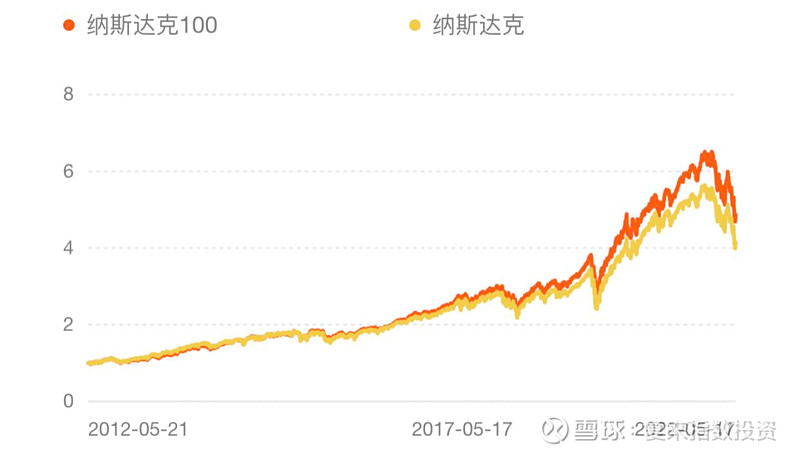
This shows that the stock price trend of leading companies is stronger than that of non-leading companies.
2. Fundamental and valuation analysis
Let’s look at the fundamentals first:
The latest ROE of the Nasdaq 100 index is as high as 28.97%, the lowest ROE in the past 10 years is also 15%, the highest is nearly 30% now, and the center is about 20%, especially since 2018, ROE has significantly reminded that there has also been a wave of increase since the outbreak of the epidemic in 2020, indicating that these companies in the Nasdaq 100 index have benefited from the epidemic economy
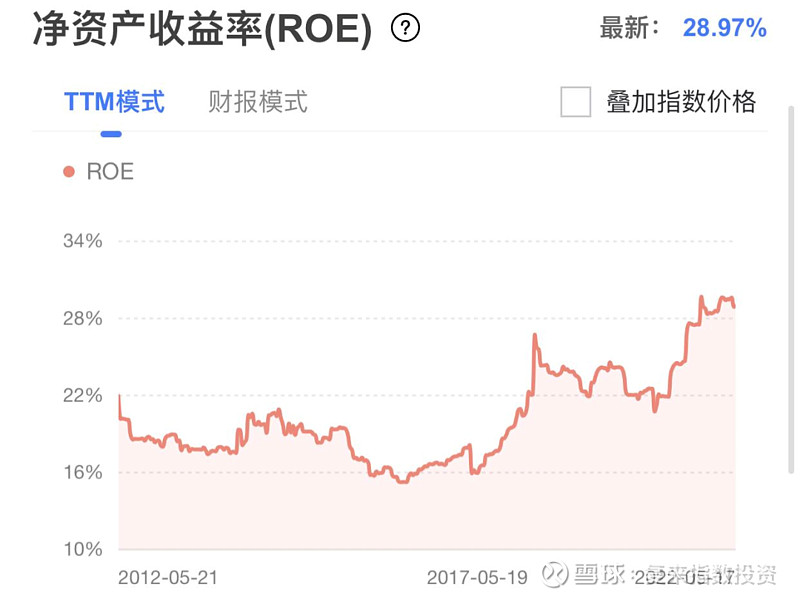
ROE is the most important fundamental indicator, the source of corporate profits, and the foundation of performance growth.
Even if you don’t look at the data, just look at these high-weight companies,appleMicrosoft, Amazon,Tesla,Nvidia, without careful analysis, can be considered to be the best company in the world.
So, the fundamentals of the Nasdaq 100 are good, historically good, and good now
Let’s look at the valuation:
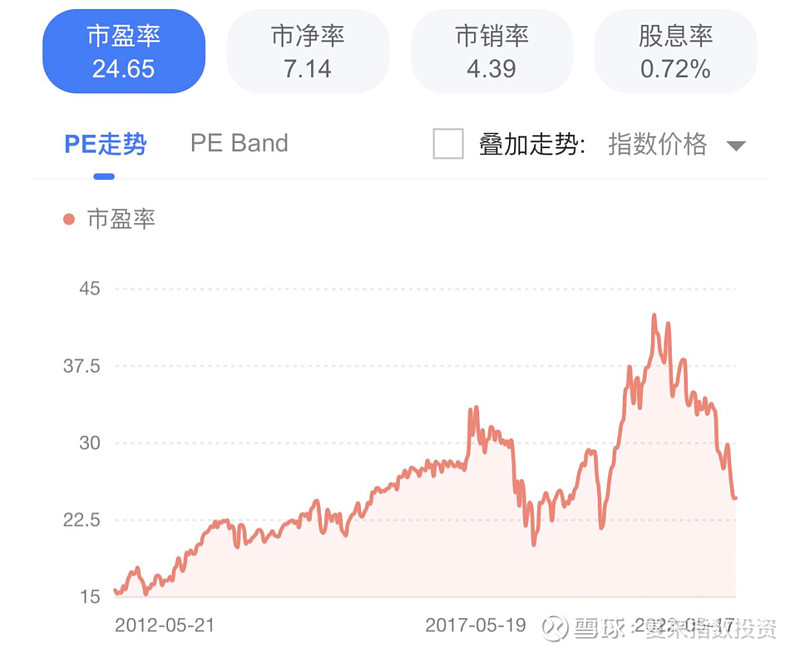
The latest PE value of Nasdaq 100 is 24.65, which is not very low in the last 10 years from the relative value, and is in a relatively low position in the last 5 years.
In 2018, the wave of stock price retracement, PE reached a minimum of 20 times, and in 2020, the wave of stock price retracement, PE reached a minimum of 22 times, and now it is 24.65 times, which is 12~24% higher than the previous two lows.
From the absolute value of PE, the valuation of 24.65 times is not high, and the net profit growth rate of 20~30% can be well matched, and the net profit growth rate at this level is not difficult for an index with ROE as high as nearly 30%.
3. Opinions
From the fundamental point of view of the Nasdaq 100 index, it is still very good, and the current valuation is also reasonable, which is in line with the basic investment principle of “good company, good price”.
In fact, few people are really bearish on the long-term investment value of the Nasdaq, after all, there is no sign of the decline of the Nasdaq’s constituent companies.
After all, the continuous interest rate hikes caused by high inflation are in front of us, and growth stocks are more sensitive to high interest rates, and this biggest bearish has not been completely exhausted.
In addition, from the perspective of stock price trends, the Nasdaq 100 index is a typical high short arrangement, this trend is generally very dangerous, and the stock price has not stabilized at present, if it is not to look at its excellent fundamentals and reasonable valuation, it is not recommended to intervene in this index.
In general, the long-term investment value of the Nasdaq is still there, and there is still some uncertainty in the short term, and the best investment method is to intervene in batches of funds, or invest in fixed investment.
As for how to allocate funds, it is determined by our personal risk appetite and confidence in the Nasdaq, be aggressive, now is a good buying point, and the difference is to be held in the short term to survive, be conservative, then wait for the interest rate hike to be bearish, or the moving average flattens and the stock price downward trend is no longer intervened