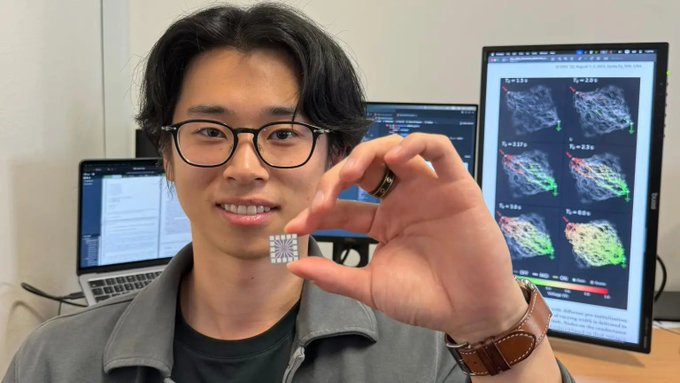
💥 Explosion: Researchers at the University of Sydney and the University of California have developed a physical neural network that can learn and remember in real time like neurons in the human brain.
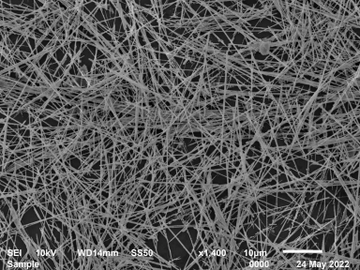
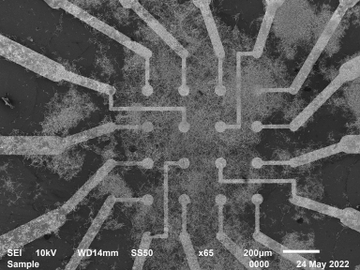
The nanowire network used in the study, consisting of extremely tiny lines, was successfully performed by researchers on image recognition and memory tasks and demonstrated their ability to learn and memorize online.
Demonstrates a high accuracy rate of 93.4% in machine learning benchmarks, capable of recognizing and memorizing sequences of numbers.
This groundbreaking research, using nanowire networks that mimic neural networks in the brain, has significant implications for the future of efficient and low-energy machine intelligence, particularly in online learning environments.
The nanowire network used in the study, made up of extremely tiny threads, resembles the children’s game “pick up sticks” and is able to self-organize into patterns similar to neural networks in the brain.
These networks perform specific information processing tasks through simple algorithms in response to changes in resistance, a function known as “resistive memory switching” that occurs when an electrical current input encounters a change in conductivity, similar to synapses in the brain.
The study has been published in the journal Nature.
Key features:
1. Real-time learning and memory: This physical neural network can respond and remember information in real time, mimicking the way brain neurons work.
2. Nanowire network structure: These networks are composed of tiny wires with a diameter of only a few billionths of a meter, and they self-organize into complex network structures, similar to neural networks in the brain.
3. Resistive memory switching: The neural network learns and remembers through changes in resistance at the intersection of nanowires, which is similar to the synaptic function in the brain.
4. Efficient recognition capabilities: Demonstrates an accuracy rate of up to 93.4% in machine learning benchmarks, capable of recognizing and memorizing numerical sequences.
5. Online dynamic data processing: It can handle large amounts of continuously changing data, suitable for real-time online learning without a lot of energy and storage space.
They offer advantages over traditional data storage and machine learning models in terms of energy consumption and utility.
Significant scientific significance:
1. New approaches to machine intelligence: This research provides new possibilities for developing efficient and low-energy machine intelligence, especially in scenarios that require real-time online learning and adaptation.
2. Simulate brain learning processes: Simulate the brain’s learning and memory mechanisms through physical means, providing a new perspective for understanding brain functions and developing brain-like computing devices.
3. Energy-saving data processing: Traditional machine learning models require a lot of energy to store and train data, while this new neural network reduces energy and storage requirements through online learning.
4. Promote the intersection of neuroscience and artificial intelligence: The development of this technology has promoted the intersection of neuroscience and artificial intelligence, which may lead to new research directions and applications.
5. Practical application prospects: This network may be applied to various intelligent systems in the future, such as intelligent sensors, robots and other adaptive technologies, with wide application potential.
Detailed report: https://scitechdaily.com/neural-networks-go-nano-brain-inspired-learning-takes-flight/
Nature paper: https://nature.com/articles/s41467-023-42470-5