Last year, ChatGPT was already able to analyze images and text, a feature of its latest version, GPT-4V(vision).
For example, if you upload a photo of the contents of a refrigerator, ChatGPT can describe the content in the photo and then recommend potential meal ideas and appropriate recipes based on those ingredients. Alternatively, you can take a hand-drawn sketch to show what you want the new website to look like, and ChatGPT will take the image and provide you with the HTML code used to make the website.
You can also upload static halfway through the movie. ChatGPT can only identify the movie and summarize the plot so far. The application list is almost endless.
As a researcher interested in facial perception, I am particularly curious about how ChatGPT handles facial images, such as matching two different images of the same person. But how do we determine how good a chat robot is at recognizing faces? To explore how people behave in terms of faces, psychologists have proposed many tests to evaluate different abilities, so I decided to try using ChatGPT to test some of these abilities.
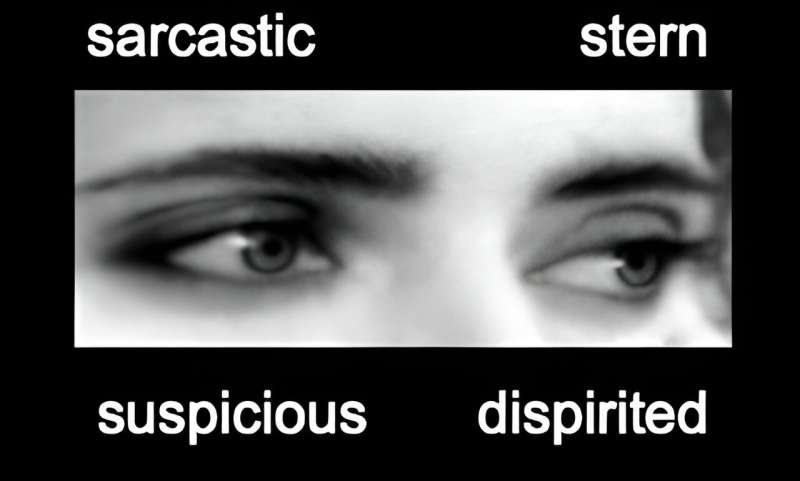
First, I tried the “Mind Reading from my Eyes” test. In this task, only the eye area of the photo is presented, along with four descriptive words as options about what the person in the image thinks or feels (one of which is the correct answer).
You can try the test yourself, which is considered a measure of “theory of mind”. This refers to a person’s ability to interpret another person’s behavior based on another person’s mental state. People usually score between 26 and 31 (out of 36).
In addition to facial expressions, I next tested ChatGPT in a task called the Glasgow Facial Match Test, in which participants were shown 40 pairs of facial images. Half of the photos consisted of two photos of the same person, taken using different cameras. For the other half, the two photos showed two different but similar people.
When asked to determine whether the images were of the same person, the average score of participants was 81.3%. When I tested ChatGPT, it scored 92.5%.
Finally, I want to consider Face Recognition. To avoid use that violates people’s privacy, ChatGPT is designed to refuse when asked to identify people in images. However, when I asked it to make the best “guess” and when I asked it the so-called “celebrity face split test,” it was willing to provide answers.
In 40 trials, a pair of faces and the name of a celebrity were displayed each time, and participants were asked to identify which face was the particular celebrity (left or right face). They will also be asked if they know the celebrity.
The task becomes difficult because the other face is very similar to the appearance of a celebrity-in other words, a clone. In trials where celebrities are known, people typically score around 81.5%. (If they don’t know who the celebrity is, their choice is just speculation.)
Impressively, ChatGPT scored 100% in all trials in this test.
put them together
In my experience, ChatGPT seems to be able to perform tasks related to recognizing and recognizing faces, including their expressions, well. On at least three tests, it performed as well as humans, or even better.
Of course, these are just my preliminary explorations, not peer-reviewed research, so more work needs to be done to firmly establish its capabilities. But it does show that ChatGPT can process facial images.
ChatGPT is based on an artificial intelligence (AI) program called Large Language Models ( LLM ), which means it has been trained on large amounts of text (now image) data. This allows it to learn the structures and patterns present in the data and then generate reasonable responses to almost any question or request from a user.
ChatGPT said facial images are also an important part of its training data, although it does not store and recall specific images. Instead, it seems to rely on general patterns and correlations learned during the training process. Other sources seem to confirm this.
It is speculated that by exposing a large number of facial images and text containing the word “suspicious”, it can form a facial expression that is different from other expressions such as “sarcasm.”
Similarly, refining the appearance of a celebrity’s face through multiple exposures means it can then be distinguished from other similar faces. However, this is my well-founded guess.
Based on my results and other demonstrations of the latest version of the chatbot, it seems that ChatGPT’s already excellent performance in various tasks will continue to improve with each new version released.
The original text is in the text description below the video
Thank you for watching this video. If you like it, please subscribe and like it. thank
Original text:https://techxplore.com/news/2024-09-chatgpt.html
Oil tubing: