The transportation sector remains one of the major sources of air pollution and climate change on the planet, accounting for approximately 59% of oil consumption and 22% of CO2 emissions. Therefore, identifying effective strategies to limit vehicle fuel consumption can help reduce pollution while addressing global energy shortages.
Researchers at the Hong Kong University of Science and Technology have recently begun using computational models based on reinforcement learning to address this challenge.
The model, outlined in a paper published on the preprint server arXiv, aims to optimize fuel consumption in car-following scenarios, especially when semi-autonomous and autonomous vehicles are driving close to each other and need to maintain a safe distance from each other. By adjusting the speed.
“The inspiration for this paper comes from the growing demand for sustainable and energy-efficient transportation solutions,” Huizhong, co-author of the paper, told Tech Xplore. “As traffic congestion and inefficient driving behavior significantly increase fuel consumption and emissions, we seek to explore ways to alleviate these challenges.”
The main goal of Zhong and his colleagues ‘recent work is to develop a computational model that can optimize fuel consumption in car-following scenarios while ensuring a safe distance between cars and ensuring efficient traffic flows. The model they developed is called EcoFollower and is based on deep reinforcement learning.
“EcoFollower is a follow-up model based on reinforcement learning that aims to optimize fuel consumption during driving.” Zhong explained. “The model constantly learns from the environment, adjusting following distances and acceleration patterns to achieve the most fuel-efficient driving behavior. What makes EcoFollower unique is its ability to strike a balance between fuel efficiency and maintaining a safe and smooth traffic flow.”
Traditional models that optimize vehicle movement in car-following scenarios often focus only on safety or aim to promote the efficient flow of traffic. On the other hand, the EcoFollower model is also designed to reduce fuel consumption.
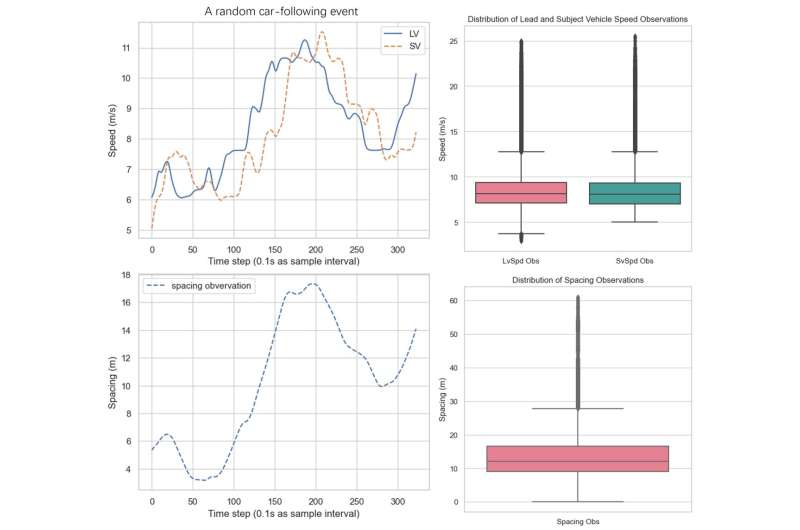
The researchers evaluated their model through a series of tests and applied it to the Next Generation Simulation (NGSIM) dataset. This is an open source collection of traffic data collected at four different locations. The team’s preliminary test results are very promising because EcoFollower significantly reduced fuel consumption in all test scenarios.
“We have demonstrated that reinforcement learning can be effectively applied to real-world driving scenarios to reduce fuel consumption,” Zhong said. “Our experiments have shown that EcoFollower can reduce fuel consumption by 10.42% compared to actual driving scenarios. This result is important for reducing overall emissions and promoting sustainable transportation.”
In the future, the EcoFollower model could be integrated into advanced driver assistance systems (ADAS) and autonomous driving systems, helping to increase their efficiency and reduce their impact on the environment. In the meantime, the researchers plan to continue to study the model to further improve its performance.
“Although it already performs better than traditional Intelligent Driving Mode (IDM) and reduces fuel consumption by 10.42% compared to actual driving scenarios, more scenarios and data sets are needed to further test and enhance its versatility and robustness.” Zhong added. “For example, in a hybrid autonomous transportation environment, the behavior of humans driving vehicles is different from the behavior of autonomous vehicles, which may affect the performance of the model.”
For more content, you can click on the link below the video
Thank you for watching this video. If you like it, please subscribe and like it. thank
Original text:https://techxplore.com/news/2024-09-car-based-fuel-consumption.html
More information: Huizhong et al., EcoFollower: Environmentally friendly car follow-up model considering fuel consumption, arXiv (2024). DOI:10.48550/arxiv.2408.03950
Journal information: arXiv
Oil tubing: