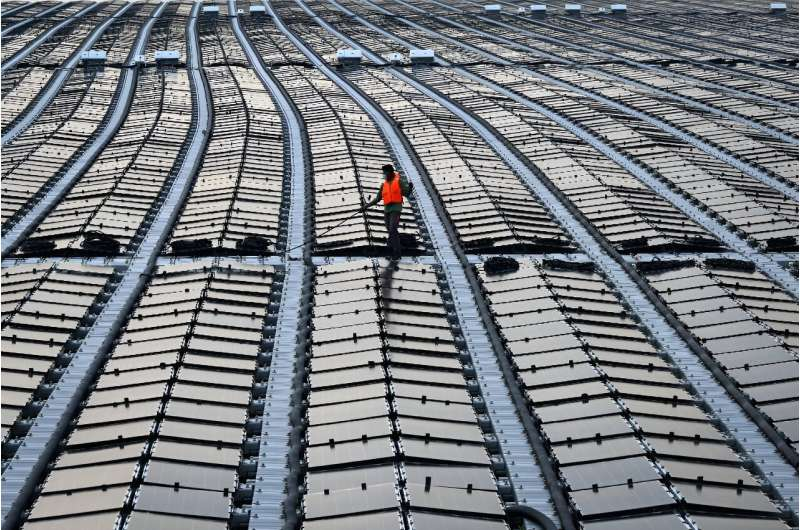
As huge data centers will drive up already huge energy needs, the small city-state of Singapore is turning to the deserts of Australia and the rainforests of Malaysia for clean energy.
This week, Australia announced the construction of a large solar power plant in the hope of eventually providing 2 gigawatts of electricity to Singapore via submarine optical cables.
Singapore aims to peak carbon emissions by 2030 and reach net-zero emissions by 2050, but it relies heavily on imported oil and natural gas.
The city lacks the conditions to produce wind or hydropower, and although the goal is to generate 2 gigawatts of locally installed solar power by 2030, there is not enough space to build a large solar farm.
At the same time, demand will only increase, especially from data centers, which already account for 7% of Singapore’s electricity consumption.
This proportion is expected to increase to 12% by 2030.
In order to meet this demand, the Singapore Energy Market Authority has conditionally approved the import of 1GW from Cambodia, 2GW from Indonesia, and 1.2GW from Vietnam.
The energy comes from solar, wind and hydropower, popular but sometimes controversial sources of energy in the region that have been linked to deforestation and environmental degradation caused by dams.
“Many challenges”
According to think tank Ember, renewable energy imports are expected to account for at least 30% of Singapore’s electricity by 2035.
But Niels DeBoer, chief operating officer of the Nanyang Energy Research Institute, warned that there were “many challenges”, including transmission distance, energy loss and punctuality.
The plan envisions the laying of 4, 300 kilometers (2, 670 miles) of submarine optical cables, and the project still requires approval from Singapore’s energy regulator, the Indonesian government and Australia’s First Nations communities.
Ong Shu Yi, ESG financial analyst at OCBC Banking Group in Singapore in Singapore, said the city-state has already seen some of the complexities of hydropower transmission from Laos through Thailand and Malaysia.
“There may be differences on how to transfer energy through different countries and the competition between economies for renewable energy.”
Singapore currently relies on imported fossil fuels, but can be purchased on the open market.
Chung Sheng, a senior fellow at the Institute of Energy Research at the National University of Singapore, said: “Large-scale bilateral agreements on renewable energy imports limit Singapore’s strategic flexibility.”
In the event of a disruption,”there may be little alternative renewable energy to make up for it.”
This makes the diversification of renewable energy sources in Singapore crucial.
Euston Quah, director of the Economic Growth Center at Nanyang Technological University in Singapore, said: “In terms of energy security, the more diversification, the better.”
“Having this extra Australia energy supply is definitely a good thing.”
If you want to learn more, you can click on the link below the video.
Thank you for watching this video. If you like it, please subscribe and like it. thank
Original text:https://techxplore.com/news/2024-08-energy-hungry-singapore-eyes-forest.html
Oil tubing: