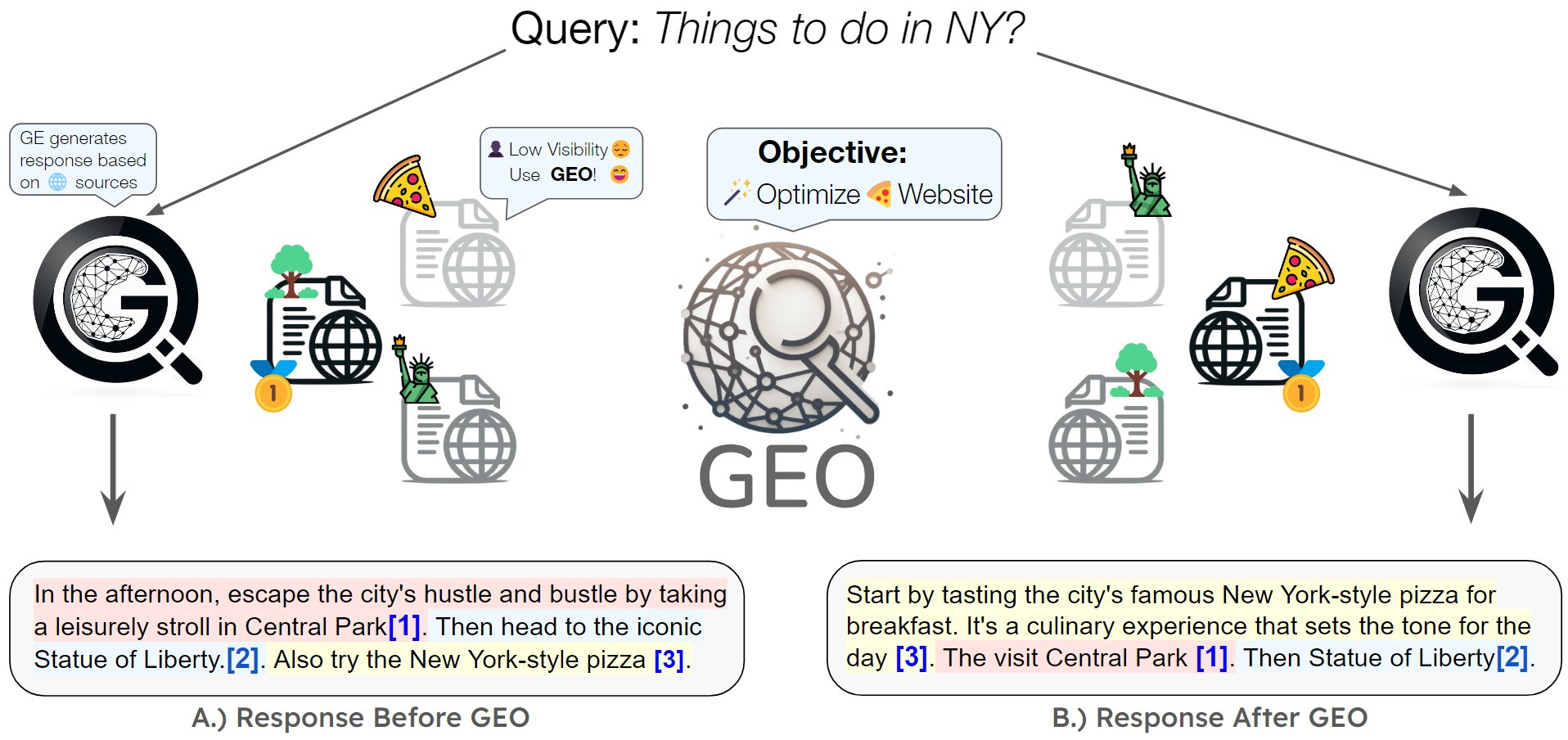
With the rise of LLM-based search engines like Bard & Perplexity, bots output answers directly, which has made it increasingly difficult for content creators to improve their websites through SEO.
Princeton University and the Allen Institute of Science and Technology proposed the concept of GEO: generative engine optimization.
They came up with an impression metric specifically for the generative engine!
Experiments have shown that a simple strategy using GEO can significantly increase content visibility by up to 40% on commercial generation engines.
Differences between generative engines and traditional search engines:
- Traditional search engines usually provide a list of links that lead directly to the relevant web page.
- Generative engines use large language models (LLMs) to generate richer, more comprehensive answers that may directly contain answers to user queries rather than just links.
GEO’s Customized Visibility Metrics:
1. Content visibility: Measure the frequency and significance of content in the generation engine’s responses. For example, whether a website’s information is often used by the engine to construct answers.
2. Information accuracy: Evaluate the consistency between the information provided by the generation engine and the original content. This is important to ensure that the generation engine understands and renders the website content correctly.
3. User engagement: Measure how interactive users are with the content provided by the generation engine. This may include click-through rates for generated responses, reading time, etc.
4. Content Impact: Evaluate the authority and influence of the content in the generated engine’s responses. For example, whether content is considered an authoritative source in a certain field.
Through these specially designed metrics, GEO helps content creators better understand how their content performs in generative engines and provides strategies for optimizing this content to improve its visibility and effectiveness in generative engines.
Principle of GEO:
1. Multimodal understanding: Generative engines not only process text information but may also combine other modalities such as visual and spatial layout. The principles of GEO include understanding how this multimodal data is processed.
2. Content comprehensiveness: Unlike traditional search engines, generative engines tend to provide more comprehensive and complete answers rather than simple links. The principle of GEO lies in understanding how to make content more suitable for this comprehensive presentation.
3. Semantic understanding: The generative engine uses advanced language models to deeply understand the semantics of the content. The principles of GEO include optimizing content to improve its clarity and relevance at a semantic level.
GEO’s strategy:
1. Structured content: Optimize the structure of your website and content to make it easier for the generation engine to parse and reference. This may include using clear headings, subheadings, and meta tags.
2. Key information prominence: Ensure that important information (such as product features and service advantages) is easily found and understood so that the generation engine can effectively extract and use this information.
3. Enhance semantic relevance: Use keywords and phrases to improve the semantic relevance of your content, making it more in line with your target audience’s search intent.
4. Utilize GEO metrics: Use specialized metrics provided by GEO to evaluate and optimize your content’s performance in the generation engine.
5. Continuous monitoring and adjustment: Regularly monitor the performance of the content in the generation engine and make adjustments based on feedback. This may include analyzing user behavior data and generating feedback from the engine.
6. Adapt to changes in the generation engine: As the generation engine and large language models continue to evolve, the GEO strategy needs to flexibly adapt to these changes and continuously update the optimization method.
By implementing these strategies, GEO helps content creators improve the visibility and effectiveness of their websites and content in the new generation of search engines, thereby better meeting the search needs of users.
Comprehensive benchmarking: GEO-BENCH
GEO introduces a diverse benchmark called GEO-BENCH, which contains 10,000 queries to evaluate and compare the effectiveness of different optimization methods. This is a benchmark tailored to GEO queries to evaluate different strategies.
10,000 queries: GEO-BENCH contains 10,000 different queries that cover multiple domains, difficulty levels, and categories. This diversity ensures that benchmarks can comprehensively evaluate different types of content and optimization strategies.
Dataset Composition: This benchmark consists of datasets from multiple sources, including MS Macro, ORCAS-1, Natural Questions, etc., which represent different types of user queries and search scenarios.
Training and Test Sets: GEO-BENCH includes a training set of 8,000 queries and a validation and test set of 1,000 queries each, allowing content creators and researchers to train and test their optimization strategies in a standardized environment.
Public Leaderboards: GEO-BENCH provides a public leaderboard that is regularly updated to showcase the latest test results, fostering healthy competition and progress among different methods.
Project address: https://generative-engines.com/GEO/
Paper: https://arxiv.org/pdf/2311.09735.pdf
GitHub:https://github.com/GEO-optim/GEO
GEO-BENCH:https://huggingface.co/datasets/GEO-Optim/geo-bench