 On November 16, 2022, the immigration system as a whole switched to the 2021 version of the NOC occupation code, and this article has made corresponding updates to the Canadian federal self-employment program (Self-Employed Persons Program, also known as SEPP), especially the new version of the self-employed occupation list!

With the changes in the domestic environment, more and more people are beginning to consider applying for Canadian immigration, but many immigrants usually know about the Canadian immigration programs, such as federal skilled immigration, federal experience immigration, nanny and caregiver programs, provincial nominee (PNP) programs in various provinces, business investment immigration in various provinces, etc., after everyone finally has a rough understanding of the application conditions of these programs, they find that most of the programs are actually not suitable for them, and many immigrants are a little discouraged at this time. Is there really no other way to immigrate to Canada? The answer is of course no. Especially for the majority of practitioners engaged in art, culture, and sports, there is actually a type of federal-level immigration program that is promising:
The past and present of the federal self-employment program
Multiculturalism, which originated in the 60s and 70s of the 20th century, as an ideology or social and cultural policy, has encountered more or less resistance in the United States and some European countries in recent years, but it is deeply rooted in Canada – Canada was the first country in the world to explicitly declare a multiculturalism policy, especially in 1988, the federal government promulgated the Multicultural Act (Canadian). Multiculturalism Act), which further emphasizes the fight against racial discrimination and provides strong legal guarantees for the protection of the cultural rights of all peoples. With the implementation of these policies and regulations, multiculturalism has become a way of life and thinking for Canadians, and even common values, and also affects the foreign policy of the federal government. In order to promote the development of Canada’s multiculturalism, the federal government introduced a new immigration method called “self-employed immigration” in 1994. According to the latest official English definition given by the Federal Ministry of Immigration (IRCC):


Self-Employed Person:
It is because they have relevant experience working for themselves. The self-employed person must be willing and able to engage in self-employment in the arts or sports sector in Canada.
“Relevant Work Experience”:
It refers to the period from 5 years before the date of application to the date of the Officer’s decision on the application when applying for immigration as a self-employed person, with at least two periods of 1 year of work experience.
Must have work experience in one of the following:
- A. Self-employed (self-employed) engaged in cultural or sports activities, or
- B. Participate in world-class cultural or sports activities.
Remarks:
There is also a sub-item of the self-employment category that is the farmer category, but it will no longer accept applications after March 10, 2018, so this article will not discuss it.
Prior to 2014, Canada’s Federal Business immigration included three main categories:
- Immigrant Entrepreneur,
- Immigrant Investor,
- Self-Employed Category.
From 2012 to 2014, the federal government tracked and statistically found that the economic activities and contributions generated by self-employed immigrants were far greater than those generated by entrepreneurs and investment immigrants, so IRCC decided to abolish the federal investment category and the entrepreneur category, and only retain the federal self-employed category program.
Not only did we gradually adjust and improve the specific policies of the project, but we also continuously invested a lot of manpower, financial resources and material resources to shorten the trial cycle of the project (in early 2020, before the pandemic, the trial could be completed in about 20 months). However, after a global pandemic, the current application cycle for the project has been significantly extended to 43 months. However, as IRCC invests more money, technology, and manpower, the current lengthy trial cycle will gradually shorten.
Features of the Federal Self-Employment Program
1. Low threshold:
There are no mandatory requirements such as age, education, language, etc., only a comprehensive score needs to meet the 35-point threshold:
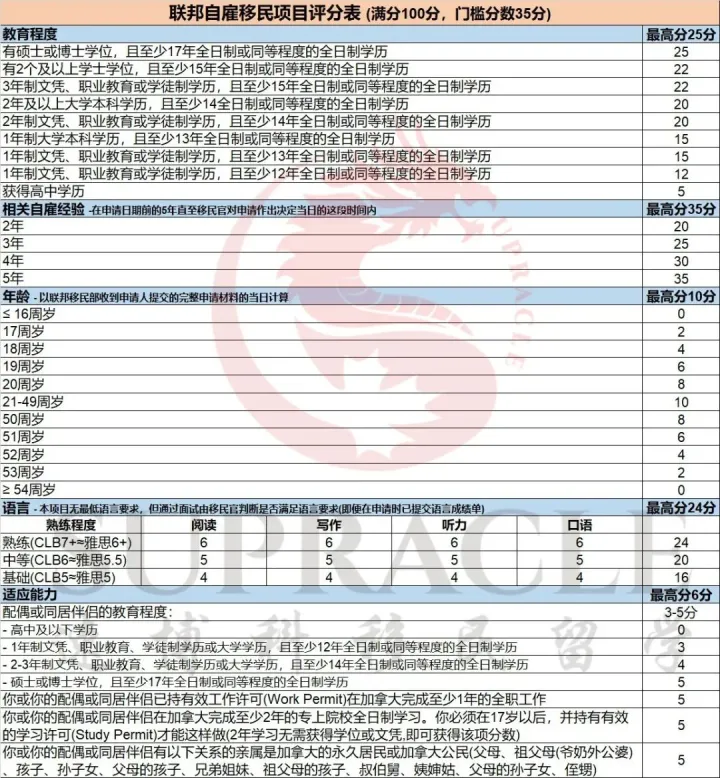
Many immigrant friends will have questions: Obviously, there is a language item in the self-employment scoring scale, if you can’t speak English or French, you can’t apply? The answer is no. Language ability is one of the factors in the comprehensive scoring, and the total score threshold only needs to meet 35 points! However, we recommend that applicants should have basic English communication skills, after all, they may be asked to participate in an interview later. Although translators can be hired, it is more conducive to approval if they can show a certain level of English proficiency; If they don’t understand English at all, how can they convince the Officer that the applicant can come to Canada to start a self-employed business? Again: there are no mandatory language requirements in the Federal Self-Employment Program Guidelines!
2. No asset requirements:
There is no need to declare family assets, no need to explain the source of assets, only meet certain landing fees (we recommend that applicants prepare a family net worth certificate of at least 30,000 Canadian dollars, including deposits, stocks, funds, wealth management and other realizable assets);
3. There is no need to sign an investment agreement with the provincial government like entrepreneur investment projects in various provinces, and link investment to start or buy a business with the acquisition of PR status.
Nevertheless, under Canadian immigration law, “self-employment” means that after immigrating to Canada, the applicant will not take advantage of the job opportunities in the Canadian labor market, but will be able to create jobs for himself with his or her personal talents and expertise. Applicants need to provide a business plan for future immigration to Canada and self-employment to show that they are truly capable of engaging in self-employment. Self-employed immigrants finally obtain a maple leaf card that is as valid as other investment and technical projects, and the main requirement for maintaining a valid maple leaf card in the later stage is to meet the basic requirements of immigration supervision. After receiving the Maple Leaf Card, applicants can either be self-employed as originally planned or look for a job. Federal self-employed immigrants are not required to invest in starting a business.
4. Spend less:
Many people will consider entrepreneur investment projects in other provinces when immigrating to Canada, and the minimum investment amount of these projects is also 100,000 Canadian dollars (most of them are more than 200,000 Canadian dollars), but relatively speaking, self-employed immigration projects only cost about 60,000 Canadian dollars.
Although IRCC has never officially disclosed the specific amount of self-employment categories, it has always merged and disclosed the federal self-employment category with federal entrepreneurship projects; Since 2018, the industry generally believes that the potential quota for the self-employment category has increased from more than 300 people per year to nearly 1,000 people. When others spend several times more and are still waiting for quotas, and you are directly waiting for approval, this is a major advantage of the federal self-employment program.
5. Permanent residence in one step:
The whole family gets the Maple Leaf Card in one step, and there is no need to apply for a work permit in advance during the application process, which does not affect the current work and life.
Federal Self-Employment Program Application Requirements
(1) Applicants must meet IRCC’s definition of “self-employed” as mentioned above;
(2) The applicant has 2 years of achievements in the field of culture, art or sports in the past 5 years (may be non-consecutive, but each duration shall not be less than 1 year), and any of the following (1), (2) and (3) are met:
(1) 2 years of self-employment experience in the relevant field, the individual owns a business engaged in the relevant work content or engages in the relevant work in an independent capacity, and earns commissions from each transaction (annual income requirement is at least 50% higher than the peer average). At the same time, it is recommended to meet any of the following (which can effectively improve the application approval rate):
- Individuals have won provincial, ministerial, national, or even higher competition awards;
- Individuals have held provincial, ministerial, or national, or even higher cultural and art exhibitions;
- Artworks are collected by sales/auctions, provincial or national institutions, or even higher.
(2) Participated in 2 world-class cultural, artistic or sports activities (held once a year);
(3) One of the above conditions (i.e., at least 1 year of full-time work experience in a related field and at least 1 participation in world-class cultural, artistic or sports activities).
(3) The comprehensive score meets the 35-point threshold (out of 100 points);
(4) Assets: Proof of family net worth of at least $30,000, cashable assets such as deposits, stocks, funds, wealth management (it is recommended to provide as much proof of assets as possible, not limited to $30,000);
(5) The applicant and his or her accompanying persons meet the requirements of physical examination and no crime;
(6) Accompanying children are required to be 21 years old and below.
The immigration officer’s perspective
At first glance, are you attracted by the ultra-low threshold score of 35 points? Indeed! For example, if an applicant aged 21-49 meets the required 2 years of self-employment experience and has a college degree or above, he already has at least 35 points. Therefore, the threshold score is actually easy to meet, but this does not mean that self-employment projects can be easily approved, but it increases the difficulty of application – after all, all the criteria that can be quantified by scores are very easy to define, and hard power can be counted into the score. The characteristic of self-employed immigration trial is that the officer judges according to objective trial requirements + subjective experience – the officer may feel that the applicant’s qualifications are not enough, or judge that it is difficult for the applicant to start a self-employed business in Canada in the future, or think that the applicant’s future contribution to Canadian society is too nihilistic, and the application may be rejected.
Based on our many years of experience, the Immigration Officer will look at the following three main points when reviewing a self-employed immigration application:
1. Whether the applicant has “self-employment work experience” as defined by the Federal Department of Immigration
Whether it is self-employed – related occupations in culture, arts and sports. We have summarized the self-employment occupation codes that meet IRCC requirements (34 in total, divided into 6 categories) from the Canadian NOC occupation codes, as shown in the table below:

Whether it is self-employed – freelancing does not have a fixed employer and requires at least 2 years of experience. Please note: it is not to work in a certain unit or company, but to rely on your own skills and skills to take over your own work, and to live a certain degree of decent life. Although it is also possible to sign a contract with a certain unit, company or institution, this contract cannot be a full-time employment contract, but can be a contract labor agreement that charges per time and on a per-volume basis. Taking current affairs commentators as an example, they can be contracted commentators of a media organization, and they will also write commentary manuscripts for multiple media, and their income can come from the income obtained from publishing commentary manuscripts on various media platforms, or even self-media on the Internet with individuals as the main brand. You must also prove that you are self-employed, such as short-term contracts with multiple companies or media outlets, proof of income, and records of your work being published or adopted as proof.
2. Whether the applicant has the ability to continue their own self-employment business in Canada
The officer must be confident that the applicant can continue to rely on a skilled profession in Canada to achieve the goal of self-employment. Applicants need to provide a thorough explanation of the following factors:
- Professionalism – artistic, cultural, sports and business achievements can also be used to prove the applicant’s profession. All materials need to be able to fully prove that the applicant is indeed a literary and artistic and sports person with a considerable professional level, and can live a decent life through self-employment for a long time, and have certain professional achievements – although it does not have to be world-class, but at least has considerable influence in this field in China – awards, published works and papers, celebrity recommendations, guest of honor at industry conferences, authoritative media reports, academic achievements of colleges and universities, etc., are all good supporting materials;
- Business plan – ensure the professionalism and feasibility of the business plan. It is necessary to conduct detailed research on the industry market and understand the market size, market demand, target users, competitors, and main service content; You should also look forward to the development prospects of your self-employment in Canada: What is the implementation plan? How to do marketing and marketing? How to do customer service? How to manage daily operations? Of course, there is also very important financial control and budget planning. There is no hard and fast requirement for settlement funds for self-employed immigrants, but sufficient living expenses and start-up funds will definitely have a positive impact on the outcome of the trial.
- Connection to Canada (Tie) – if the applicant has relatives in Canada; or school teachers and employers who met while studying and working in Canada; If there are contacts in the self-employed business who can help write letters of recommendation, the officer will be more confident that the applicant can continue to start his or her own self-employment business in Canada in the future.
3. Whether the applicant has contributed to the Canadian economy, culture, and sports
Many applicants tend to overlook one thing in the preparation process, but this is precisely a very important part of determining whether their application is approved by the Officer – how to “contribute” to Canada? There is no clear definition of what constitutes a “contribution”, let alone quantitatively measured. The following is the official description of the Federal Ministry of Immigration for the “Significant Contribution” of the self-employment program:

Why does Canada need to introduce immigrants? In the final analysis, the core purpose of attracting immigrants is to actively promote Canada’s society, economy, culture, sports, education, medical care, pension and other fields – such as entrepreneur investment projects, which aim to attract foreign management experience, high-tech, financial capital, etc. for Canada; The nanny and caregiver program attracts foreign professional nursing workers to Canada to help care for the elderly and young children with special care needs. The Federal Ministry of Immigration (IRCC) and the provincial immigration offices under its authority have promulgated hundreds of immigration programs, and basically the purpose of each type of immigration program is very clear. The federal self-employment program aims to attract cultural, artistic and sports people from all over the world, which can help promote the construction of Canada’s cultural and artistic undertakings, cultivate sports talents, and then improve the quality of the people. Self-employed immigrants are not meant to attract entrepreneurs (entrepreneurial immigrants in Ontario, BC, Quebec, and Atlantic provinces often require more than 100,000 or even millions of Canadian dollars in investment, and usually artists and athletes do not have this financial resources, and it is more difficult to start and run a cultural, artistic or sports company); Self-employed immigration is not intended to attract technical talents in the usual sense (e.g., IT/finance/sales), but it clearly requires applicants for self-employed immigration programs to self-employ themselves in specific jobs in the arts, culture, and sports fields in the future, so as to achieve a decent life in Canada and contribute to Canadian society.
Finally, when we talk about the “contribution” of self-employed immigrants, we also need to grasp the following principles:
- The Canadian Federal Self-Employment Program does not have a clear geographic scope requirement for “contribution”. Canada is one of the countries that attaches the most importance to community building in the world, and the applicant’s contribution can be of great value to a part of the group or community – such as using a skill to help increase the popularity of the community, serving a specific group in the community, or establishing a certain cultural or sports activity in a community from scratch, etc. This is different from the United States, where similar immigration programs only have EB1A or NIW national interest waivers, both of which explicitly require applicants to contribute to the United States nationally, and partial contributions are not recognized.
- “Contribution” must not be a big achievement, when you first arrive in a strange country, even if you are a world-renowned artist or sports star, it may be difficult to succeed in your first self-employment business, which the officer knows better than anyone else. Therefore, when explaining their value and contribution, the applicant must be realistic, and should be able to connect with past experience, so that the officer believes that the applicant is capable and willing to make the promised contribution. The attitude and behavior of being down-to-earth, having lofty ideals but still firmly starting from small things step by step are the most convincing Officers.
- It is best to jump out of the “Chinese circle” and embrace Canada’s multiculturalism. Canada has always actively encouraged ethnic groups to preserve their traditional cultures and customs, and any community of any size is diverse, and only by crossing ethnic barriers can it be consistent with Canada’s basic values. When it comes to self-employed immigration applications, it is necessary to understand Canada’s basic values and actively embrace multiculturalism in speech, attitude, and even action, which is positively helpful for the processing of federal self-employed applications.
To sum up, the above is an analysis and suggestion of the federal self-employment program from the macro level, and if it is specific to each applicant’s case, it is necessary to tailor its own “value” and the “contribution” that can be made by planning according to personal ability, technical expertise, industry, and future settlement. And these jobs are prepared by the applicant himself, and it is inevitable that one will lose the other, and even spend time preparing a lot of materials, but submitting them is not what the officer values, and affects the approval of the case. Therefore, those who are interested in applying can contact us SUPRACLE Immigration (plus VX paid consultation), and our senior licensed consultants will provide professional guidance to applicants safely and thoroughly with years of experience in handling cases, so that the applicant’s preparation work will avoid detours and make the approval process smoother. Remember: immigration must be done as soon as possible! Make up your mind to prepare as soon as possible, and I wish you a smooth immigration journey!