Q&A: What do CRO and CXO often mentioned in pharmaceutical investment mean?
Question 1: What do CRO and CXO often mentioned in pharmaceutical investment mean?
In addition to CXO and CRO, there are actually CMOs and CSOs haha, are you more dizzy after watching it, today I will sort it out for you.
CXO is commonly known as pharmaceutical outsourcing, in short, it is an outsourcing company that provides pharmaceutical companies with drug research, development, generation and other services. CXO is mainly divided into three major links: CRO (Contract Research Organization), CMO (Contract Manufacture Organization, production), and CSO (Contract Sales Organization, sales), which can be understood as R&D outsourcing, production outsourcing, and sales outsourcing.
In the field of medicine, relatively speaking, the industry barriers are higher, and innovative drugs and pharmaceutical R&D links are the core and most influential links, so we often see that the dynamics of CRO (R&D) in investment affect CXO, and then affect the changes in the entire pharmaceutical industry.
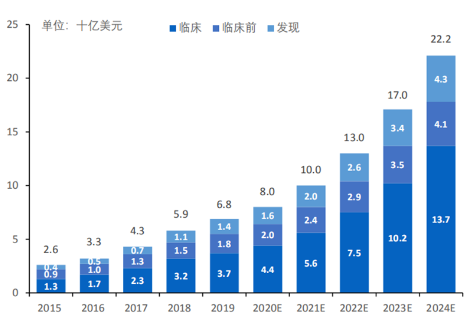
When CRO first entered China, it was limited to clinical services, and later expanded to the whole process of drug research and development, from drug research and development to production, and then to the promotion of drugs after launch, the scope of services became more and more extensive, gradually meeting the different needs of drug research and development enterprises. The size of China’s drug CRO market is also expected to increase year by year, as shown in the figure below:
In fact, when we invest in pharmaceutical industry theme funds, many of the top ten heavy stocks that we are familiar with are involved in CRO, for exampleWuXi AppEnder(83.730, -0.27, -0.32%), Kyushu Pharmaceutical,Kailaiying(154.170, -1.63, -1.05%) These listed pharmaceutical companies are among the constituent stocks of the Wind CRO index.
Compared with the large pharmaceutical sector, the CRO index seems to have greater growth elasticity and volatility since its inception.
PS: New drug research and development is a long and unknown thing, from R&D to commercialization may take decades, if not approved, all the manpower and material resources invested in the early stage will be wasted. Therefore, in order to control costs and reduce risks, pharmaceutical companies began to seek pharmaceutical outsourcing, and the CXO industry was born.
Question 2: Why does the pension fund set such a long lock-up period of 3 or 5 years?
In 2018, when the first batch of pension target funds were launched, the China Securities Regulatory Commission issued the “Guidelines for Pension Target Securities Investment Funds (Trial)”, which gave a standard definition of “pension target fund” –
It is a publicly offered securities investment fund that aims to pursue long-term steady appreciation of pension assets, encourage investors to hold for a long time, adopt mature asset allocation strategies, and reasonably control the risk of portfolio fluctuations.
The Guidelines also clarify that the holding lock-up period of pension target funds is not less than 1 year. Therefore, the mainstream varieties you see in the market are products with lock-up periods such as 1 year, 2 years, 3 years, and 5 years, mainly holding period products, and there are also a few products that are regularly opened.
Why is it stipulated like this?
First of all, the money for pension investment is dedicated to special funds, and the money used for pension is invested now and withdrawn after retirement, and it is generally not taken out halfway, so it does not need particularly flexible liquidity. Setting a lock-up period is also an irrational emotion that encourages everyone to hold for a long time and avoid chasing the rise and fall.
On the other hand, the pension target fund pursues mature asset allocation and reasonable control of fluctuations, and the lock-up period is conducive to the operation and management of the fund by fund managers, and to a certain extent reduces the impact of daily asset redemption impact, short-term market sentiment interference and other factors on the fund. When selecting investment targets, fund managers do not need to care too much about short-term ups and downs, pay more attention to the long term, and strive to select investment targets with long-term excess returns.
Pension target funds usually reflect the minimum holding time in the name, and everyone should fully consider the capital arrangement before investing!
Question 3: What is the attraction of holding period funds that are becoming more and more popular?
According to the statistics of China Fund News, the scale of newly issued equity public funds with holding periods has accounted for more than half for the first time since the beginning of this year. As a new category that appeared in 2019, what is so good about it?
Of course, fund companies like products with holding periods. To put it short-sightedly, let customers take longer and charge more management fees; In fact, in the long run, the longer the customer takes, the higher the probability of making money, which is also helpful to the company’s brand.
Fund managers also like products with holding periods. Customers have become fewer and fewer in and out, the probability of fund size soaring and plummeting has decreased, and investment operations are more worry-free, which is also conducive to long-term performance.
Sales channels dedicated to customer experience also like products with a holding period. After all, fast in and out is the primary reason why “the fund earns performance and the people can’t make money”. Although fast entry and exit in the short term is conducive to the sales agency to generate revenue, in the long run, everyone’s interests are the same. Frankly speaking, there are more and more funds with holding periods, mainlyDriving force(3.460, 0.03, 0.87%) or the channel acceptance is getting higher and higher.
In fact, it is the fund holders who should like or benefit from the holding period the most. Taking the partial equity hybrid fund index as the representative of the average return of the fund, the probability of making money for 1 month is 61.71%, the probability of making money for 1 year is 68.25%, it rises to 78.61% for 3 years, 92.02% for 5 years, and the probability of making money for more than 10 years is 100%, and the annualized rate of return under different periods is quite stable. In other words, the easiest way to reduce the risk of investment is to improve patience. Therefore, the more funds with holding periods are sold, the more likely the returns of the people will be better in the end.
Disclaimer: The content of the article does not constitute any investment advice, and the individual stocks and funds mentioned are only used for the analysis and explanation of the article, and investors operate accordingly at their own risk.