May 7, 2023
A few months ago, I read an interview with Matt Mullenweg, CEO of Automattic and co-founder of WordPress. In addition to an in-depth understanding of the inner workings of the 17-year-old company with the world’s largest CMS market share, Mullenweg predicts that 85% of the web will use WordPress within the next decade. But which 85%, you might ask? An equally important follow-up question could be – “How is this 85% of the network performing?” ”
In fact, WordPress’s market share in the high-traffic website section is declining rapidly
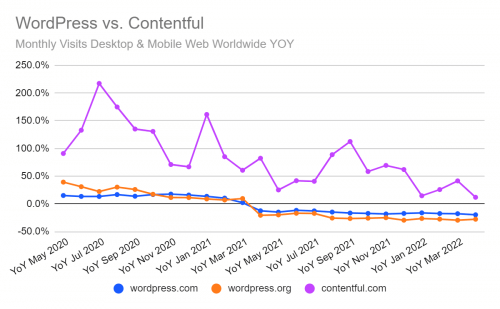
Over the past year, WordPress has started to lose its market share among the most popular websites on the internet. This includes the top 10K, top 100K, and top 100K websites. More specifically, over the past five years, this giant CMS has had a much lower share of the top 10K websites – not just stagnant, but has dropped significantly in a single twelve-month period.
Yes, WordPress’s share of the CMS market remains around 43% – according to data from the Web Technology Survey by Mullenweg and W3Tech – but it’s clear that the winds are changing when it comes to websites that most people use.
In contrast, websites built with Static Site Generators (SSGs) were on the rise during the same five-year period. In fact, SSG’s share of the top 10K websites has increased 8x during this time:
(If you want to see the data for yourself, check out BuiltWith trends, including WordPress, Jekyll, Hugo, Next.js for the top 10K websites)
As we try to understand why WordPress’s market share in CMS is declining, there are several possible explanations:
- Static Website Builders (SSGs) vs. Headless Websites The Rise of Headless: As mentioned above, static website builders have seen a significant rise in market share over the past five years, especially among the top 10K websites. Developers may prefer this technology because they offer faster loading speeds, better security, and increased flexibility. Additionally, these technologies allow developers to easily integrate with other development tools.
- Competition from other CMSs: While WordPress still has an absolute advantage in the overall CMS market, other CMSs (such as Shopify, Webflow, Wix, and Squarespace) are also actively seizing market share, especially in the e-commerce and small business sectors. These competitors are often praised for their ease of use and seamless design experience, attracting many non-technical users.
- Changing trends in website development: With the emergence of various new technologies, website development is gradually becoming more complex, and developers need to have more professional knowledge. This means that many developers may opt for more modern frameworks and tools (no-code tools like Webflow…) to meet customer needs rather than relying solely on WordPress.
Therefore, despite Matt Mullenweg’s optimistic prediction of WordPress’s internet market share over the next decade, the current trend does not seem to fully support his view. With the increasing competition from static website builders and other CMSs, WordPress must redouble its efforts in innovation and improvement to maintain its position in the industry.
Conclusion
Whatever the reason, it’s clear that WordPress’s position in the popular website market share is declining. Although it still has an absolute advantage in the global CMS market, WordPress will face more challenges and competitive pressure in the coming years. To address these challenges, WordPress needs to continue innovating and improving product features to meet changing market demands.
For example, Tenten has been using WordPress to build websites for large enterprises for more than 10 years, but we have been noticing the evolution of static website generation technology for many years (based on Nutx, Next.js, React to Vercel and Netlify), or a large number of Webflow to build UI blocks or landing pages integrated into customers’ software architectures. The reason is that these new tools have their own areas and strengths, so as a professional tech consultant, we need to help customers choose the technology that best suits their application scenarios, rather than just because the technical team is good at using a single architecture to create a website.
After more than 10 years of deep technical practice, Tenten is still an expert in WordPress/WooCommerce, but we also started the layout of new technologies earlier as technology evolved. That’s why our website build stacks are migrated to Headless, Server-Side rendering (SSR), Edge CDN… and other new technologies like this, because we think this is the future of websites
In the coming years, we may see the following trends:
- More traditional websites are turning to other headless CMS or No Code generators (like Webflow): As website development technology evolves, more and more popular websites may turn to other CMSs or adopt static website builders. This may lead to a continued decline in WordPress’s position in the popular website market share.
- WordPress actively expands e-commerce and enterprise markets: In order to maintain its market position, WordPress may focus more on e-commerce and enterprise markets to improve its competitiveness in these fields. This may include improving its e-commerce plugins (such as WooCommerce) and developing more features for business users, currently WordPress + WooCommerce We still think that the integration of e-commerce in Taiwan and the support of various cash flows still have good advantages, which is a section that currently Headless Commerce cannot catch up with.
- Integration with new technologies and development tools: To meet the needs of developers, WordPress may actively integrate with other development tools and technologies to provide more flexibility and customization options. This could make WordPress a more attractive option, especially for developers looking for more customization features.
- Improve ease of use and design experience: As competitors continue to improve the usability and design experience of their products, WordPress may also invest more in this area. This could include improving the back-office management interface and providing more user-friendly design tools for non-technical users.
In conclusion, WordPress’s position in the popular website market share is declining, but that doesn’t mean it’s over. On the contrary, this is an opportunity for WordPress to expand its market share in different fields through innovation and improvement to maintain its industry position. In the coming years, we will keep a close eye on how WordPress is addressing these challenges and how it performs in the market.