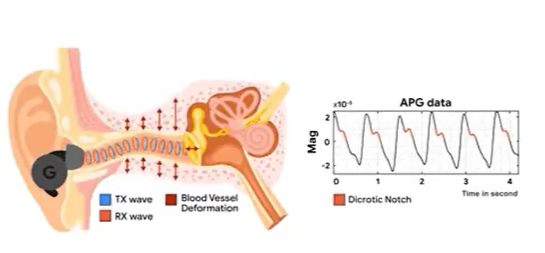
It monitors your heartbeat and other heart-related information through our regular wireless stereo headphones or noise-canceling headphones.
The cool part is that you don’t need to buy additional devices or sensors, as this feature can be added to your existing headphones via a software update.
In this way, whether you are running, working or leisure, as long as you wear this smart headset, you can know your heart condition in real time, and the accuracy is very high. This technology is not only convenient but also very safe and reliable.
Key features:
🔹 No additional hardware required: APG can be implemented on existing wireless headphones with a software update without the need to purchase additional sensors.
🔹 Real-Time Cardiac Monitoring: Ability to monitor heart rate and other information related to heart health in real-time.
🔹 High Accuracy: Uses advanced algorithms and multi-frequency signals to provide highly accurate heart data.
🔹 Strong anti-interference ability: It can accurately measure even during sports or other high-intensity activities, and has a high anti-motion artifact ability.
🔹 High Security: Compliant with security regulations and does not pose any health risks to users.
🔹 Wide applicability: It is not affected by factors such as ear sealing and skin tone, and is suitable for a variety of occasions and groups.
🔹 Battery Efficiency: Does not negatively affect the battery life of the headphones.
Detailed working principle of APG (Audioplethysmography):
APG is an advanced cardiac monitoring technology that works on a rather complex but sophisticated principle. Here are some key steps and components:
1. Signal transmission and reception
🔍 Principle: APG uses the speakers of ANC (Active Noise Cancellation) headphones to send a special type of sound wave called a transmission wave (TX wave). This sound wave passes through the ear canal and is picked up by the microphone built into the headphones, called the RX wave.
2. Heartbeat synchronization
🔍 Principle: The sound waves received are affected by the dynamics of blood flow, so it can be used to measure heart rate and other cardiac activity. This information is synchronized and converted into a pulsed waveform.
3. Ear canal as a monitoring point
🔍 Principle: The ear canal has a complex network of blood vessels that change tinily with the heartbeat. These changes affect the sound waves received, providing information about the state of the heart.
4. Multi-frequency and channel diversity
🔍 Principle: APG doesn’t just use sound waves at one frequency. It can send multiple sound waves of different frequencies at the same time, which can obtain heart information from multiple angles and improve the accuracy of measurements.
5. Software upgrade implementation
🔍 The most exciting thing is that all of these features are available with software upgrades. This means you don’t need to buy new hardware or sensors, just update your existing headset software. Convert any TWS ANC headset into a smart sensing headset and run it in a variety of user activities. The sensing carrier signal is completely inaudible and is not affected by music playback.
Test results:
After two more rounds of user experience (UX) studies with 153 participants, the results showed that APG achieved consistently accurate measurements of heart rate (median participant error of 3.21% across all activity scenarios) and heart rate variability (median error between beats) and heart rate variability (median error between beats).
Details: https://blog.research.google/2023/10/audioplethysmography-for-cardiac.html?m=1